Common Scams in Thailand 2026

Thailand is easy to travel. That is part of the problem. You land, the airport works, your hotel answers quickly, QR payments are everywhere, and before long you stop checking whether the person on the other end of the screen is actually who they say they are.
The old scams have not gone away. The tuk-tuk still detours to the gem shop. The jet-ski still comes back with a scratch you did not make. But the scams doing the most damage in 2026 often start before you arrive: a perfect booking confirmation, a cloned villa agent, or a message containing details only your real hotel should know.
You do not need to be suspicious of everyone. You just need to slow down when somebody changes the payment method, creates a deadline, or moves you away from the platform where you booked.
The short answer
- A message can contain your real hotel, dates, and reservation number and still be fake.
- Never send full card details or a one-time passcode through WhatsApp, LINE, email, or a link someone messages you.
- Confirm villas, tours, transfers, and drivers through the property or operator's official contact details—not the number that contacted you.
- Do not scan a stranger's QR code. Check payment QR stickers for tampering before using them.
- Vapes are illegal in Thailand. Leave yours at home, and never settle a supposed police matter in cash on the street.
- Photograph every side of a jet-ski or scooter before touching it.
- Use Grab or Bolt, or insist on the meter. Do not agree to an off-meter street fare.
- Tourist Police: **1155**. Cyber-fraud hotline: **1441**.
Fake hotel booking confirmations
Imagine you’re two weeks from your trip. A WhatsApp message arrives from your hotel. It has the right logo, your name, your exact dates, and your reservation number. The message says your card failed and the room will be cancelled in 30 minutes unless you “verify” it.
You tap the link. The page looks exactly like Booking.com. Your stay is already filled in. All it asks for is your card number, expiry date, security code, and the one-time passcode your bank sends next.
That last code is not confirming your room. It is approving the scammer’s transaction.
This works because the details can be real. Criminals target hotel systems and partner accounts, then use stolen booking data to make the message feel impossible to fake. The design is not the proof. The information is not the proof. The channel is what matters.
How to protect yourself:
- Stay inside the booking platform. Open the app yourself and check the reservation. Do not use the link in the message.
- Call the hotel on a number you find independently. Use its official website or the number shown inside your original booking—not the number in the WhatsApp message.
- Treat a deadline as a warning. “Pay in 30 minutes or lose the room” is there to stop you checking.
- Never give out a one-time passcode. A hotel does not need the code your bank sends to approve a payment.
- Do not re-enter a full card in chat. Real hotels do not ask for your complete card number on WhatsApp.
If the message moves you off-platform and creates a clock, stop. Be careful!
AI-cloned villa and travel agencies
Imagine you’re planning a week in Phuket with friends. You find a villa page using the name and photos of a real property. The “agent” replies instantly, answers every question, sends a polished contract, and even calls you. The voice sounds calm, local, and professional.
You transfer the deposit. When you arrive, the villa exists—but your booking does not.
AI has made this easier. A copycat can generate natural replies around the clock, reproduce a brand’s tone, and clone a voice from public videos. The technology is new. The scam is not.
In August, Thai police arrested a woman in Phuket over alleged phantom villa bookings after two Russian tourists lost a combined ฿2 million. Earlier in 2026, a Saraburi man was arrested over fake hotel and villa Facebook pages; about ฿20 million had reportedly moved through the account used in the scheme.
How to protect yourself:
- Verify the property through a second channel. Find the villa’s official website or a major booking platform and contact it there.
- Ask the property to confirm the agent by name. Do not ask the agent to confirm the property. That proves nothing.
- Compare the bank-account name. A request to pay an unrelated individual or a newly introduced account is a reason to stop.
- Be skeptical of bank-transfer discounts. A cheaper price is not worth giving up card protections and a platform record.
- Save everything. Keep the listing, profile URL, messages, contract, receipt, and recipient account details.
A real property will survive ten minutes of verification. A fake one depends on you not taking them.
QR-code swaps and the “dead phone” favor
Imagine you’re at a café in Bangkok. A friendly stranger says their phone died and asks you to scan a QR code for them. It sounds harmless. You point your camera at it, and a page opens asking you to approve a small payment or install an app.
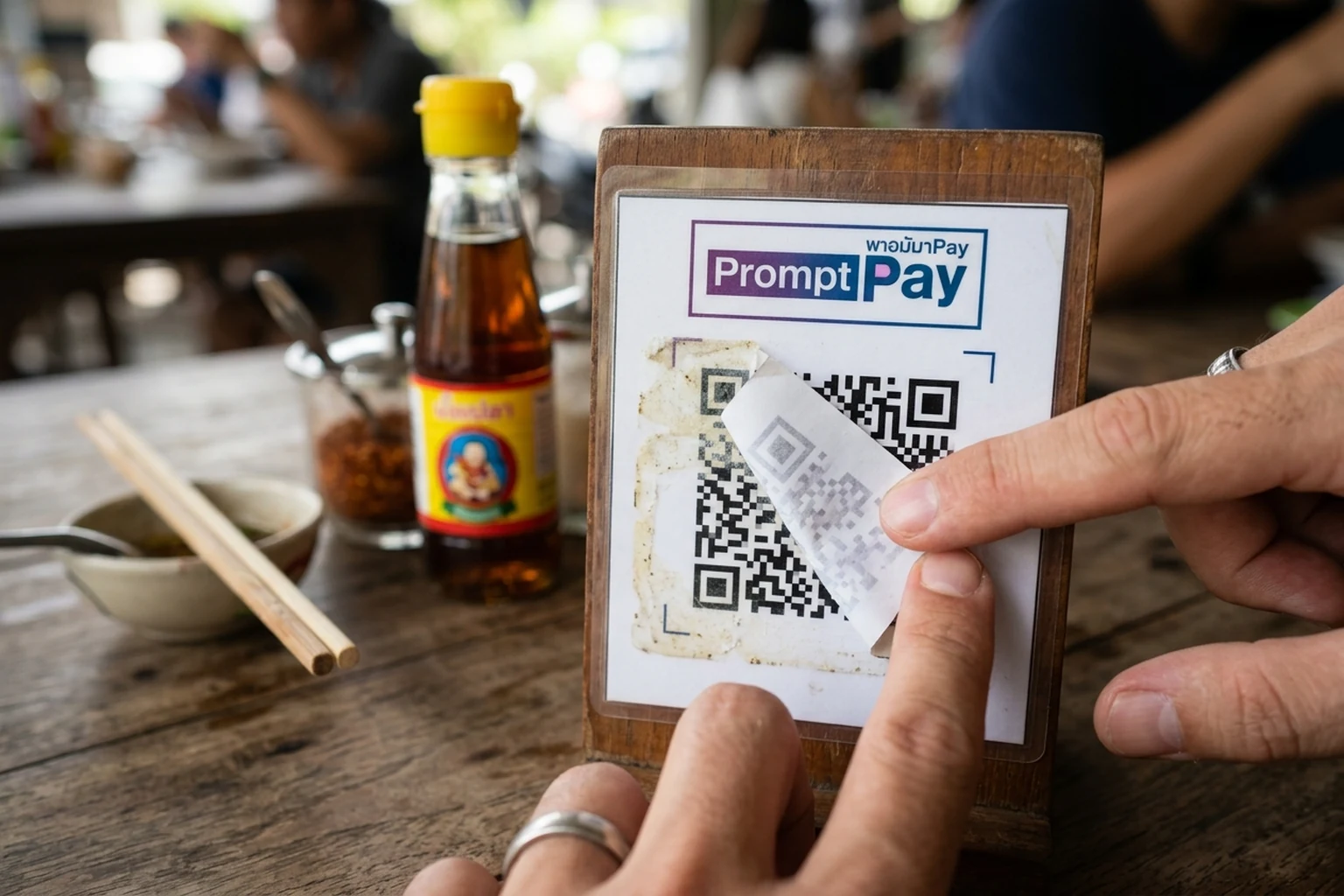
Or nobody approaches you at all. A fresh sticker has simply been placed over the real QR code on a restaurant table, parking meter, or donation box. You think you are paying the business. The money goes somewhere else.
How to protect yourself:
- Do not scan codes for strangers. Their dead battery is not your problem.
- Touch the edges. A sticker placed over another code may lift, bubble, or sit crooked.
- Read the destination before opening it. Close the page if the domain is unfamiliar or redirects repeatedly.
- Check the recipient and amount. Do this inside your payment app before approving.
- Never install an app from a QR prompt. Use the official App Store or Google Play listing you find yourself.
- Ask staff. At a restaurant, confirm the table code before entering payment details.
The code itself cannot tell you who printed it. Be careful!
Fake LINE and WhatsApp accounts
Imagine you’ve been messaging a hotel about an airport pickup. A second LINE account appears with the same logo and nearly the same name. It says the driver changed and sends a new payment QR. Or you find an unofficial Facebook agent offering a ferry transfer or island tour below the price everyone else quotes.
The messages feel connected because the copycat has copied the operator’s photos, schedule, language, and public contact details. You pay. The driver never comes, the ferry ticket does not exist, and the account disappears.
How to protect yourself:
- Start from the official page. Use the contact link on the hotel’s or operator’s own website.
- Question any account change. A new profile, new phone number, or new payment account needs independent confirmation.
- Do not trust the logo. Profile images and display names take seconds to copy.
- Compare the price. A transfer far below the normal market price is not a secret local deal.
- Use a payment method with recourse. Avoid sending an irreversible transfer to a stranger found through a Facebook post.
The scam is not always a fake business. Sometimes it is a fake account wearing a real business’s face.
Virtual kidnapping
Imagine you’re alone in a hotel room when someone claiming to be foreign police calls. They know your name. They say your identity is tied to a crime. You must stay on video, speak to nobody, move hotels, transfer money for “verification,” and send photos proving you are following instructions.
Then they tell your family you have been kidnapped.
That is virtual kidnapping: the victim is physically safe but psychologically isolated and controlled. In a May–June 2026 case, scammers coerced a 21-year-old Chinese student into staging her own abduction. About HK$1.4 million was moved through money-mule accounts before Thai and Hong Kong police located her unharmed.
How to protect yourself:
- Hang up. Real police do not conduct an investigation by ordering you to stay on a secret video call.
- Call the agency independently. Use an official number, not the one supplied by the caller.
- Tell someone immediately. Isolation is the mechanism. Contact family, hotel staff, your embassy, or Tourist Police at 1155.
- Never transfer “verification” money. Police do not need you to move funds into a safe account.
- If a relative receives a ransom demand, verify first. Contact the person directly, call their hotel, and involve police before paying.
If the caller says secrecy is required, that is the moment to bring someone else in.
Vape shakedowns
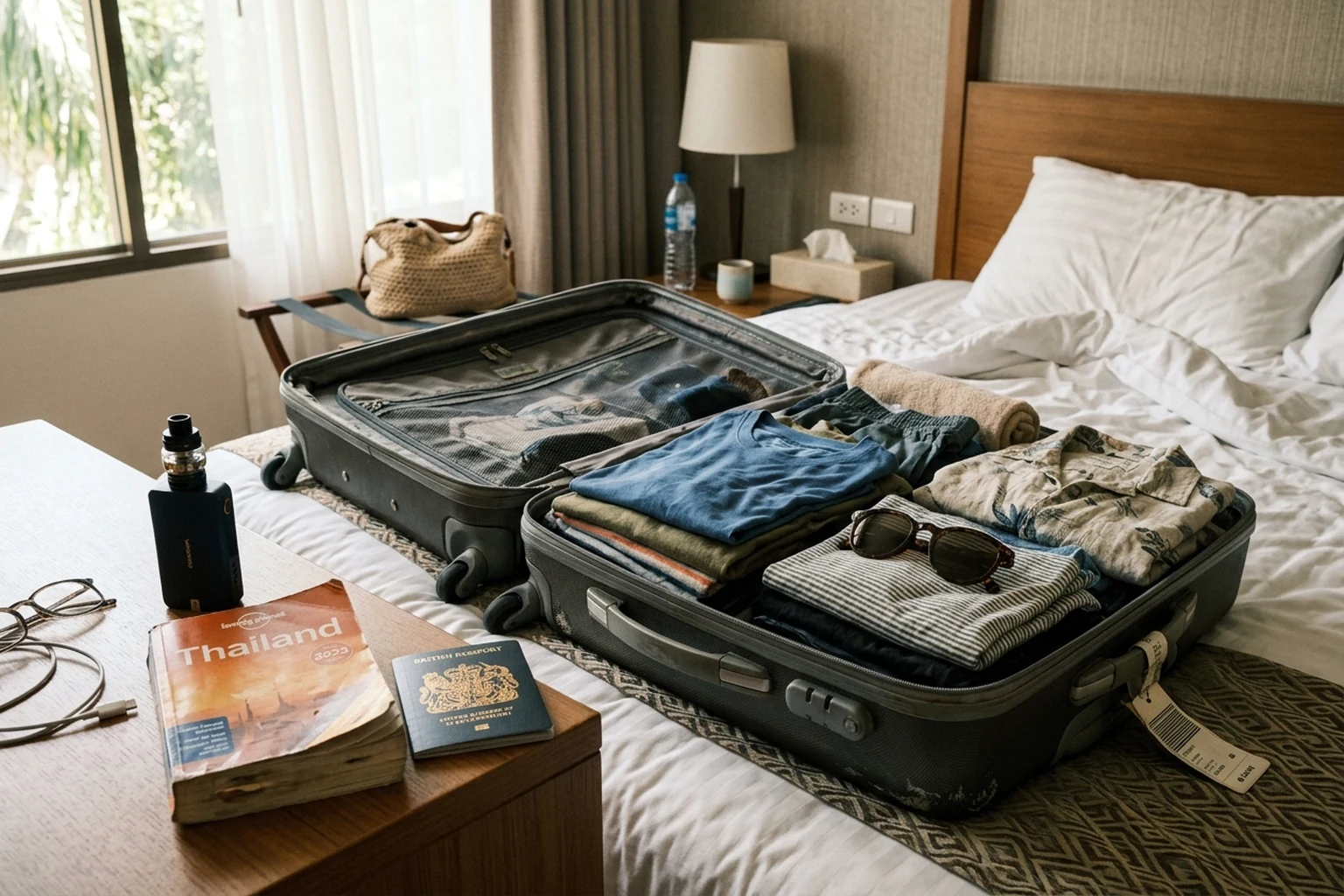
Imagine you’re vaping outside a bar when two men approach and show what look like police credentials. They tell you vaping is illegal—which is true—and demand ฿20,000–30,000 in cash immediately. Pay now, they say, or you will be arrested, miss your flight, and spend the night in jail.
Vape shakedowns are 2026’s fastest-growing scam. Thailand’s vape ban gives the threat a real foundation, and that makes a fake or corrupt on-the-spot settlement frighteningly convincing.
How to protect yourself:
- Leave the vape at home. E-cigarettes, pods, liquids, and heat-not-burn devices can create real legal trouble in Thailand.
- Do not negotiate a cash payment on the street. Real officers take you to a station and make a report.
- Ask for identification and the station name. Stay calm and do not physically resist.
- Call Tourist Police on 1155. Ask for English-language help and verification.
- Do not follow anyone to an ATM. A demand for immediate cash is the clearest warning.
The fact that vaping is illegal does not make a street cash demand legitimate. But the only clean way to avoid the trap is not to carry one.
Fake Thailand Digital Arrival Card sites
Imagine you search for the Thailand Digital Arrival Card and click the first result. It has flags, seals, and an urgent-processing option. You pay for a form that the Thai government provides free.
The official portal is tdac.immigration.go.th. The TDAC costs nothing. Our full guide explains when to submit it and how to avoid the paid copycats.
How to protect yourself:
- Type the official address yourself. Do not assume the first sponsored search result is the government.
- Pay nothing. A site charging a processing or urgency fee is not the official portal.
- Check the domain. The real portal ends in .go.th.
Jet-ski and scooter damage extortion
Imagine you rent a jet-ski on Patong Beach. When you return, the operator points to a scrape underneath the hull. You never saw it. Three more men arrive. The repair demand grows while your passport is still behind the counter.
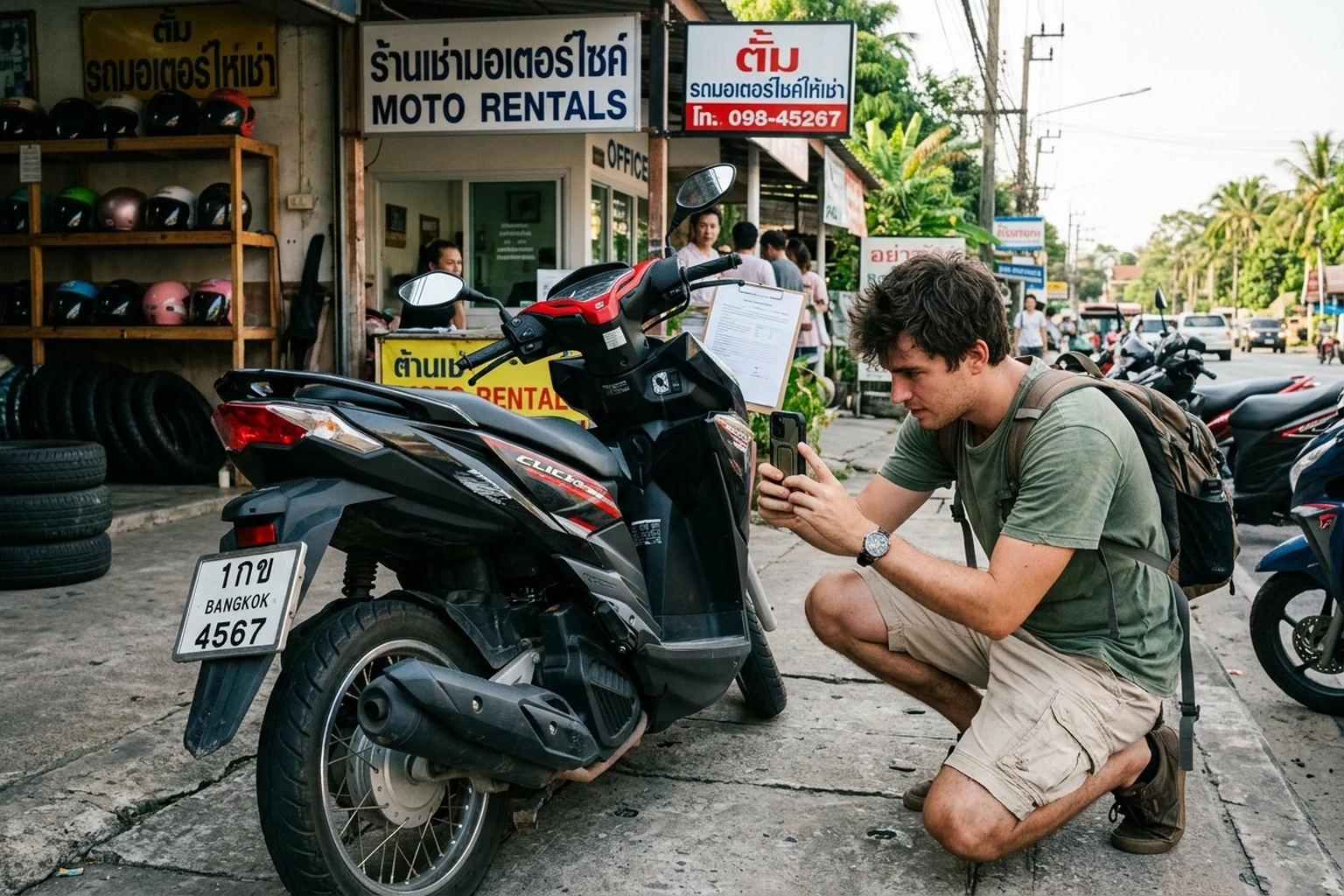
The same setup happens with scooters: old scratches, cracked panels, or mechanical damage are blamed on the last tourist to bring the vehicle back. Once the argument starts, a memory of what the machine looked like is not evidence.
How to protect yourself:
- Photograph everything before touching it. Take a continuous video as well as close-ups of every mark.
- Make the operator acknowledge existing damage. Put it on the contract or show it clearly in a time-stamped message.
- Do not leave your passport as collateral. Offer a copy or use a company with a normal deposit policy.
- Use a reviewed rental business. A beachside handshake gives you very little leverage later.
- If threatened, call 1155. Do not let a group pressure you into an ATM withdrawal.
The safest jet-ski is the one you do not rent. If you do rent one, document it like you already expect an argument.
Taxi and tuk-tuk games
Imagine you step out of Phuket Airport after a long flight. A driver says his is the last taxi available and quotes ฿3,500. You do not know the distance or the normal fare, so you agree.
That happened to an Australian tourist in September. The journey should have cost ฿800, according to the driver at a later meeting with transport officials. He refunded ฿2,700.
Elsewhere, the script is simpler: the meter is “broken,” the driver takes a long route, or a tuk-tuk fare quietly changes when you arrive.
How to protect yourself:
- Use Grab or Bolt. The app records the driver, route, and quoted price.
- Use the official airport queue. Ignore anyone recruiting passengers inside arrivals.
- Insist on the meter. If a taxi driver refuses before the trip begins, get out.
- Agree to nothing off-meter on the street. Especially when the price is vague or the driver says there is no alternative.
- Keep your bags with you until the fare is settled. Your suitcase in the trunk becomes leverage.
A transport shortage that appears the moment you land is usually a sales tactic, not an emergency.
“The temple is closed” and the gem shop
Imagine you’re walking toward Bangkok’s Grand Palace or Wat Pho when a friendly stranger stops you. “Closed today,” he says. A ceremony, a holiday, a private event—something that sounds plausible. But he knows another temple that is open, and his friend’s tuk-tuk can take you for almost nothing.
The cheap tour ends at a gem shop or tailor. Staff tell you there is a one-day government sale and that the stones can be resold at home for a profit. There is no special government gem sale. The driver and the friendly stranger receive a commission for delivering you.
How to protect yourself:
- Walk to the entrance. Only staff at the site can tell you whether it is closed.
- Ignore unsolicited substitute tours. A stranger with a ready-made itinerary is working.
- Do not buy gems as an investment. If the profit were guaranteed, the shop would not need a tuk-tuk driver to find buyers.
- Leave the shop. You do not owe anyone a purchase because the ride was cheap.
- Choose your own driver and destination. Do not let the person who approached you design the day.
The temple is usually open. Keep walking.
Two quick classics
The ATM currency-conversion trap. The machine asks whether you want to be charged in your home currency. It feels helpful because you recognize the number. Decline it and choose Thai baht. Your own bank or card network generally handles the conversion instead of accepting the ATM operator’s displayed exchange rate.
The airport SIM upsell. The bright kiosk beside baggage claim is convenient, but the bundle may include far more data or days than you need at a tourist price. Check the package length and allowance, compare the carrier’s normal plans, and buy in town or use an eSIM if the airport offer does not fit your trip.
What to do if you have already paid
- Call your bank immediately. Ask whether it can freeze the card, stop the transfer, or flag the recipient account.
- Call 1441 for online fraud. Speed matters when money has just moved.
- Call Tourist Police on 1155. Use this for in-person scams, threats, language help, or an operator holding your passport.
- Preserve the evidence. Screenshot the profile, phone number, messages, payment QR, bank details, receipt, and listing before the account disappears.
- Do not pay a recovery agent. A second person promising to retrieve the money for an upfront fee may be the next scam.
Thailand is not uniquely dangerous. It is popular, busy, digital, and full of travelers making decisions while tired. That is enough opportunity for old tricks and new technology to meet.
If Japan is next, read the companion guide to common scams in Japan in 2026.
Sources: Booking.com partner phishing and messages containing real reservation details , Phuket villa booking arrest and the earlier fake-hotel-page case , Thailand's “small favor” QR-code scam , Tourism Authority of Thailand account of the virtual-kidnapping case , Phuket taxi driver's ฿2,700 refund after a ฿3,500 airport fare , Jet-ski damage scams in Phuket and Pattaya , Thailand's vape ban and penalties for travelers , Thailand visitor and cyber-fraud reporting numbers .
Good Trip keeps local etiquette, scam warnings, emergency numbers, offline phrasebooks, and currency conversion on your phone. Download it before you fly.
Take Good Trip offline.
Culture tips, phrasebooks, scam warnings, and emergency data for Japan, Korea, Vietnam, Mexico, and 26 other countries.
Get Good Trip on the App Store →