Common Scams in Vietnam 2026

Vietnam is one of the best-value travel countries in the world. It is also the place where I paid $25 for a seafood dinner that should have cost about $5, on my first day, because a server led me away from the priced menu and over to a tank of live fish.
That meal is why I started paying attention. Most Vietnam scams are not elaborate. They catch you in the first forty-eight hours, when the currency still looks like Monopoly money, you are tired from the flight, and you do not know what a normal price or process looks like yet.
Here is what normal looks like — and what to do when somebody tries to replace it.
The short answer
- **Use the official e-visa portal:** [evisa.gov.vn](https://evisa.gov.vn). The visa is $25; third-party sites charge $60–$150.
- **At the airport, verify everything:** Match your ride’s plate, driver name, and photo inside your own app before moving.
- **Never leave your passport as a deposit:** Not for a motorbike, tour, SIM, or anything else.
- **Fix prices in writing:** This matters for seafood, tailoring, tours, and rentals.
- **Count your change slowly:** The 20,000 and 500,000 VND notes are easy to confuse when you are new.
- **Real police do not investigate you over a video call:** Hang up, contact your hotel or embassy, and call police on **113** if you are in immediate danger.
Fake e-visa websites
Imagine you are applying for your Vietnam visa. The site looks official, uses a government-looking seal, and ranks above the real portal in search. You enter your passport details, upload your photo, and pay $120. Either the company submits the same $25 form for you, or you arrive at check-in with no visa at all.
The only official portal is evisa.gov.vn. Any other site charging $60–$150 is a reseller or a scam. I covered the domain tricks, application process, and new arrival card in the full Vietnam e-visa guide.
How to protect yourself:
- Type the address yourself. Do not trust a search ad or booking-site link.
- Check the price. The official single-entry visa fee is $25.
- Read the domain character by character. One extra letter is enough to send your passport and card details somewhere else.
Be careful!
Fake cheap flight tickets
Imagine you are trying to travel around Vietnam near a holiday. A Facebook page offers a domestic ticket far below the airline’s price. The seller says the fare comes from an “internal discount” because a relative works as a pilot or airline employee. There are only two seats left. You need to transfer the money now.
The page may copy Vietnam Airlines branding and look convincing right up until the booking code fails. Vietnamese authorities warned about this exact setup around the September 2 holiday. The same warning said 959 cyber-fraud cases caused roughly 1,500 billion VND in losses in the first half of 2026. The cheap ticket is not the only risk; the payment and personal details you send can create a second scam later.
How to protect yourself:
- Buy from the airline or an authorized agent. A social-media page is not a ticket office.
- Verify the booking before paying. Check the itinerary directly with the carrier.
- Treat bank-transfer pressure as the answer. A real fare does not depend on sending money to a stranger in the next five minutes.
- Ignore the staff-relative story. Pilots’ cousins do not run secret discount desks on Facebook.
Fake police and immigration video calls
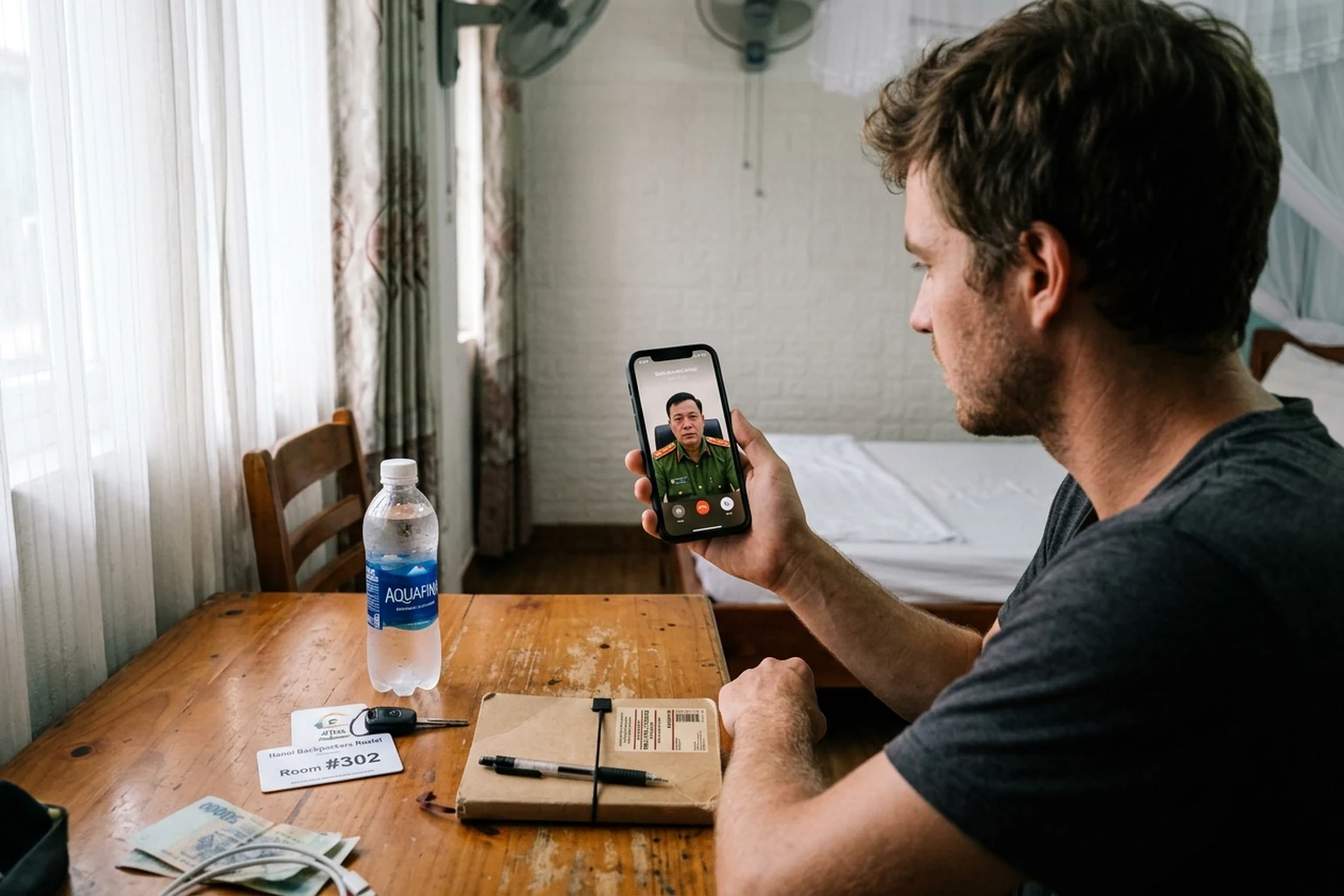
Imagine your phone rings the day after you arrive. The caller knows your name, passport nationality, and arrival date. A uniformed “officer” appears on video and says your visa is invalid or your name is connected to a crime. You must transfer money for verification, keep the investigation secret, or report to an office whose address they provide.
The details make it frightening, but they may have come from a data breach or booking record. Real officers do not direct criminal or immigration investigations over video calls and do not ask you to transfer money to clear your name. A street version exists too: counterfeit-uniform “inspectors” approach tourists, demand to see cash or documents, and invent a fine.
How to protect yourself:
- End the call. Do not argue, explain, or let them keep you under pressure.
- Do not send money or install an app. Those requests make the call fraudulent.
- Verify independently. Ask your hotel, embassy, or a real police station — not any number or address the caller gives you.
- Keep your passport in your control. A stranger in a uniform does not get to walk away with it.
- Call 113 in an emergency. If someone is threatening or detaining you, get to a public place and call police.
Be careful!
Fake Grab drivers at airports
Imagine you step out of Noi Bai or Tan Son Nhat with a Grab booking open on your phone. A man points at the screen, says, “Grab,” and tells you he is your driver. He takes your suitcase, asks you to cancel the booking because the app is “not working,” and starts walking toward a different car.
He may have seen the app on your screen. He may quote the fare shown, then add airport fees or demand cash once your bag is in the trunk. The real driver is still waiting somewhere else.
How to protect yourself:
- Match all three details. Plate, driver name, and photo must match inside your own app.
- Do not show strangers your booking screen. Ask the driver to tell you your name instead.
- Never cancel because a driver tells you to. If the real driver cannot complete the ride, handle it inside the app.
- Keep your suitcase until the car is verified. Your bag in a trunk becomes leverage.
Vacation ownership and timeshare pitches
Imagine somebody at a hotel lobby or tour desk offers you a free lunch or spa treatment for attending a short presentation. Two hours later, you are being sold years of luxury holidays as an “investment-grade travel product.” The price is available today only, and everybody in the room seems amazed you have not signed yet.
Then you try to book the holiday. Nobody answers.
A complaint in Lam Dong in April 2026 described a customer who paid 375 million VND for vacation ownership and got silence when trying to use it. The danger is not just a bad room. It is a long contract, a large upfront payment, and promises that become difficult to enforce once you leave.
How to protect yourself:
- Walk away from same-day contracts. A real investment survives twenty-four hours of thought.
- Do not confuse travel with property. “Ownership,” “membership,” and “investment” can describe a product with no useful resale value.
- Take the contract away. If they will not let you review it independently, do not sign it.
- Pay nothing to unlock a prize. The free lunch exists to keep you in the room.
Taxi meter games
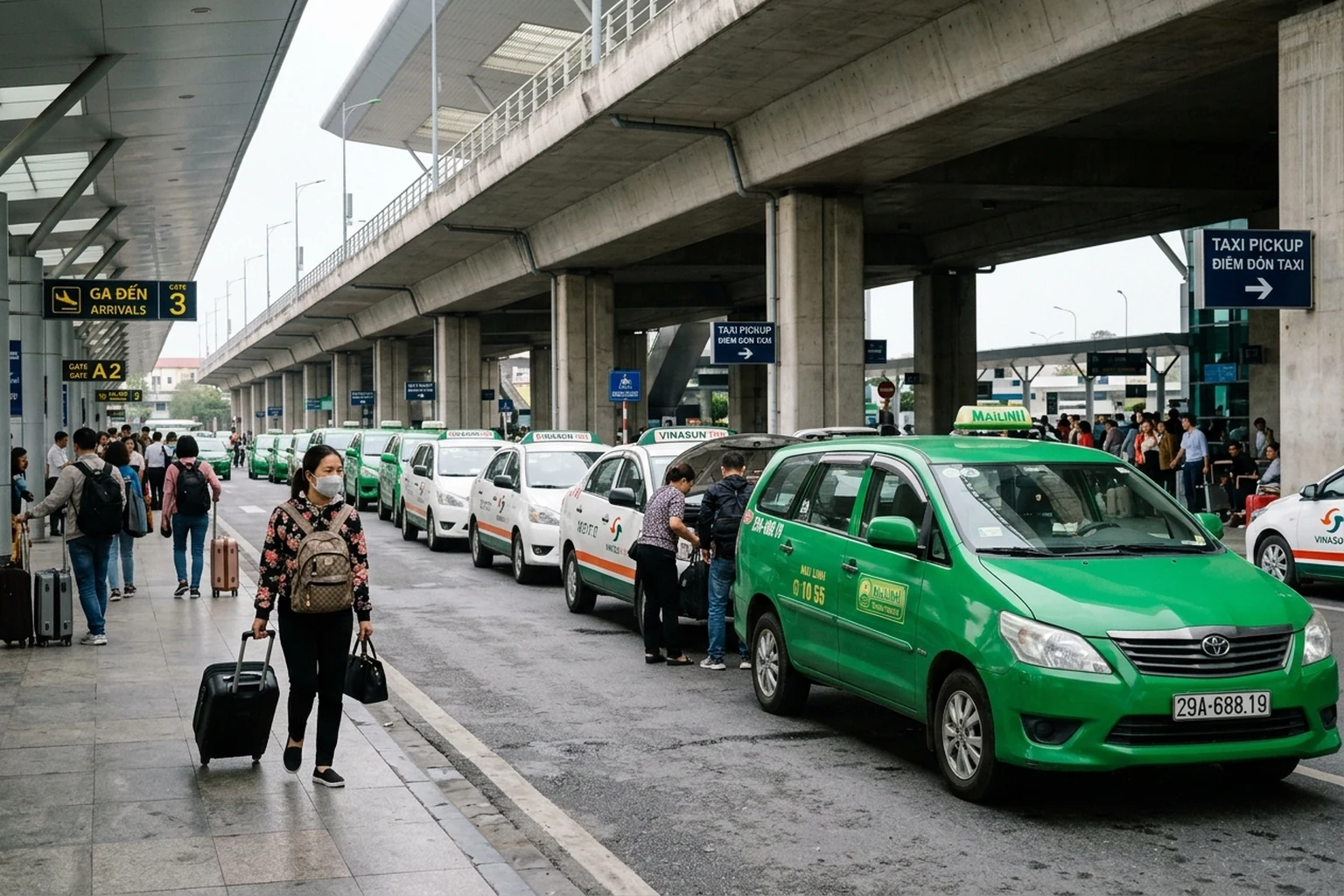
Imagine you land at Noi Bai after midnight. A driver offers to skip the queue and take you to Hanoi’s Old Quarter. The meter climbs too fast, the route circles away from the city, and the fare at your hotel is several times what it should be. When you refuse, the driver keeps your bag locked in the trunk or takes you to an ATM.
Airport taxis are issue number one because that is where you are most tired and know the least. Scammers around Noi Bai have escalated beyond fast meters to forcing ATM withdrawals. A normal taxi from the airport to the Old Quarter is roughly 280,000–400,000 VND, depending on traffic, vehicle, and pickup charges. Not every amount above that is automatically fraud, but a wildly higher demand is not normal.
How to protect yourself:
- Use a known option. Grab, Be, Xanh SM, or established fleets such as Mai Linh and Vinasun.
- Start at the official rank. Drivers approaching you inside arrivals are selling the ride on their terms.
- Check the route. Keep your map open and question a large detour early.
- Watch the meter. If it jumps unusually fast, ask to stop somewhere public.
- Do not go to an ATM. Get your bag, enter a hotel or busy business, and call 113 if you are threatened.
Be careful!
Motorbike rental damage traps
Imagine you rent a motorbike in Ha Giang, Da Nang, or Nha Trang. The owner keeps your passport as a deposit. When you return the bike, he finds a scratch under the fairing and says it is new. The repair will cost 2–10 million VND. You know the mark was already there, but your passport is behind the counter.
That passport is the scam’s strongest tool. Once somebody else controls it, a made-up damage claim becomes very hard to walk away from.
How to protect yourself:
- Never leave your passport. Offer a reasonable cash deposit, a copy, or choose another shop.
- Video the entire bike. Film every panel, mirror, wheel, light, and existing scratch before riding.
- Get the terms in writing. Price, deposit, insurance, return time, and damage policy.
- Check the bike works before leaving. Brakes, tires, lights, horn, fuel gauge, and helmet all matter more than the paint.
- Do not pay a vague repair demand. Ask for a written estimate and involve police if your passport is being withheld.
Currency confusion and money switching
Imagine you hand a taxi driver a 500,000 VND note. He folds it into his palm, shows you a blue 20,000 VND note, and says you underpaid. You are blocking traffic, scooters are honking, and you cannot remember which blue note you handed him. You pay again.
The 20,000 and 500,000 VND notes look similar to new arrivals. Sometimes the wrong change is an honest mistake. Sometimes the “mistake” is a test to see whether you count.
How to protect yourself:
- Say the denomination out loud. “Five hundred thousand” before it leaves your hand.
- Pay with smaller notes. Break large bills at convenience stores or established businesses.
- Count change deliberately. Do it before you put anything into your wallet or step away.
- Use the zeros, not the color. Blue is not enough information.
- Keep your cash organized. Separate high-value notes so you do not reach for one by accident.
Restaurant overcharging
Imagine you sit down near a beach or market. A server says the printed menu is old and leads you to a seafood tank with no prices. You choose a fish, a few dishes, and drinks. The final bill includes a cooking fee, service charge, wet tissues you never asked for, and seafood priced at two to five times what you expected.
Or the bill simply includes phantom dishes and extra beers. The argument starts after you have eaten, when the restaurant has all the leverage.
This is the scam that got me in Vietnam. The expensive lesson was simple: if the price is not written down, it is not agreed.
How to protect yourself:
- Ask the full price before ordering. For seafood, confirm whether it is per item, per 100 grams, or per kilogram.
- Get it in writing. A photo of the menu or a price typed into your phone prevents convenient misunderstandings.
- Check the weight. Watch seafood being weighed and confirm the number before it goes to the kitchen.
- Review the bill line by line. Count drinks, dishes, taxes, and fees before paying.
- Leave when there is no priced menu. Hunger is cheaper somewhere else.
Be careful!
Hoi An tailor traps
Imagine you walk into a Hoi An tailor with a photo of a suit. The first quote is $200. Then the fabric you liked is suddenly “premium,” the lining costs extra, the shirt is separate, and the rush fitting carries a fee. By the final fitting, the total is $400–$700 — or the wool you chose has quietly become a cheaper blend.
Hoi An has excellent tailors. The trap is the moving agreement: price, material, design, and deadline change one conversation at a time until you cannot remember what the original deal included.
How to protect yourself:
- Fix the total price in writing. Include every garment, alteration, lining, button, and delivery charge.
- Record the exact fabric. Photograph the label and swatch you selected.
- Pay a deposit, not the full amount. Keep enough unpaid to make the final fitting matter.
- Leave time for corrections. Do not schedule your last fitting two hours before leaving town.
- Inspect before accepting. Check seams, fit, fabric, zippers, and buttons in good light.
Misrepresented Ha Long Bay and Sapa tours
Imagine you book the cheapest Ha Long Bay cruise in Hanoi. The photos show a polished boat, private cabin, cave visit, and full lunch. The actual boat is older, the “included” kayak costs extra, one stop disappears, and the return transfer leaves before the itinerary is finished.
In Sapa, the same pattern can mean a different hotel, an unlicensed guide, extra transport fees, or a trek shortened because the advertised villages were never really in the plan. Rock-bottom pricing works because you cannot compare the brochure with reality until you are hours away.

How to protect yourself:
- Book through your hotel or a known operator. Somebody with a reputation to protect is easier to hold accountable.
- Get the itinerary in writing. Boat name, cabin type, hotel, stops, meals, transport, and return time.
- Ask what is not included. Entrance fees, kayaks, drinks, cable cars, and village transfers are common surprises.
- Do not buy on price alone. A deal far below every comparable tour usually removed something important.
- Save the listing. Screenshot the photos and inclusions before the seller edits them.
Three quick-fire classics
These are smaller, faster, and still annoying enough to spoil an afternoon.
The fruit-basket photo ambush
Imagine a vendor places a carrying pole or basket in your hands and offers to take a photo. The moment the picture is done, the free prop becomes a purchase and the price becomes an argument.
How to protect yourself:
- Do not accept unsolicited objects. Keep your hands down and keep walking.
- Agree on a price before the photo. If you actually want it, state the amount first.
“Your hotel is closed”
Imagine your driver looks at your booking and says the hotel closed, changed its name, or is full. Luckily, he knows another place. That hotel pays him a commission; yours may be open and waiting.
How to protect yourself:
- Contact the hotel yourself. Use the number in your original booking.
- Insist on the booked address. Do not let the driver choose where you sleep.
Overpriced airport SIM cards
Imagine you land without service and the airport counter sells you a $30–$40 “unlimited” SIM. In town, a comparable plan costs around $10–$15 — and the airport package may have less data than promised.
How to protect yourself:
- Check the actual data allowance. “Unlimited” often has a high-speed cap.
- Wait if you can. Airport Wi-Fi will usually get you to the hotel; buy from an official carrier shop in town.
- Test it before leaving. Confirm data and calls work on your phone.
Before you go
You do not need to travel Vietnam suspicious of everybody. You need to recognize the handful of moments when somebody benefits from keeping you tired, rushed, embarrassed, or confused. Slow the moment down. Check the plate. Count the zeros. Ask the price. Keep your passport.
That’s the whole reason I built Good Trip — scam warnings for Vietnam and 25 other countries, offline, free, no account, no data collected.
Traveling onward? Read the series sibling: Common Scams in Japan 2026.
Be careful!
Sources: Vietnam National Electronic Visa system , Vietnam E-Visa 2026: The $25 Form People Pay $150 For , Online Fraud and Scams in Vietnam — Safer Internet Lab , Tourist scams in Vietnam — Digit Insurance , Scams in Vietnam and how to avoid them — Vietnamtour.in , Common Scams in Japan 2026 .
Good Trip keeps local etiquette, scam warnings, emergency numbers, offline phrasebooks, and currency conversion on your phone. Download it before you fly.
Take Good Trip offline.
Culture tips, phrasebooks, scam warnings, and emergency data for Japan, Korea, Vietnam, Mexico, and 26 other countries.
Get Good Trip on the App Store →