Mexico City's Day of the Dead Parade Is Ten Years Old. A James Bond Film Invented It.
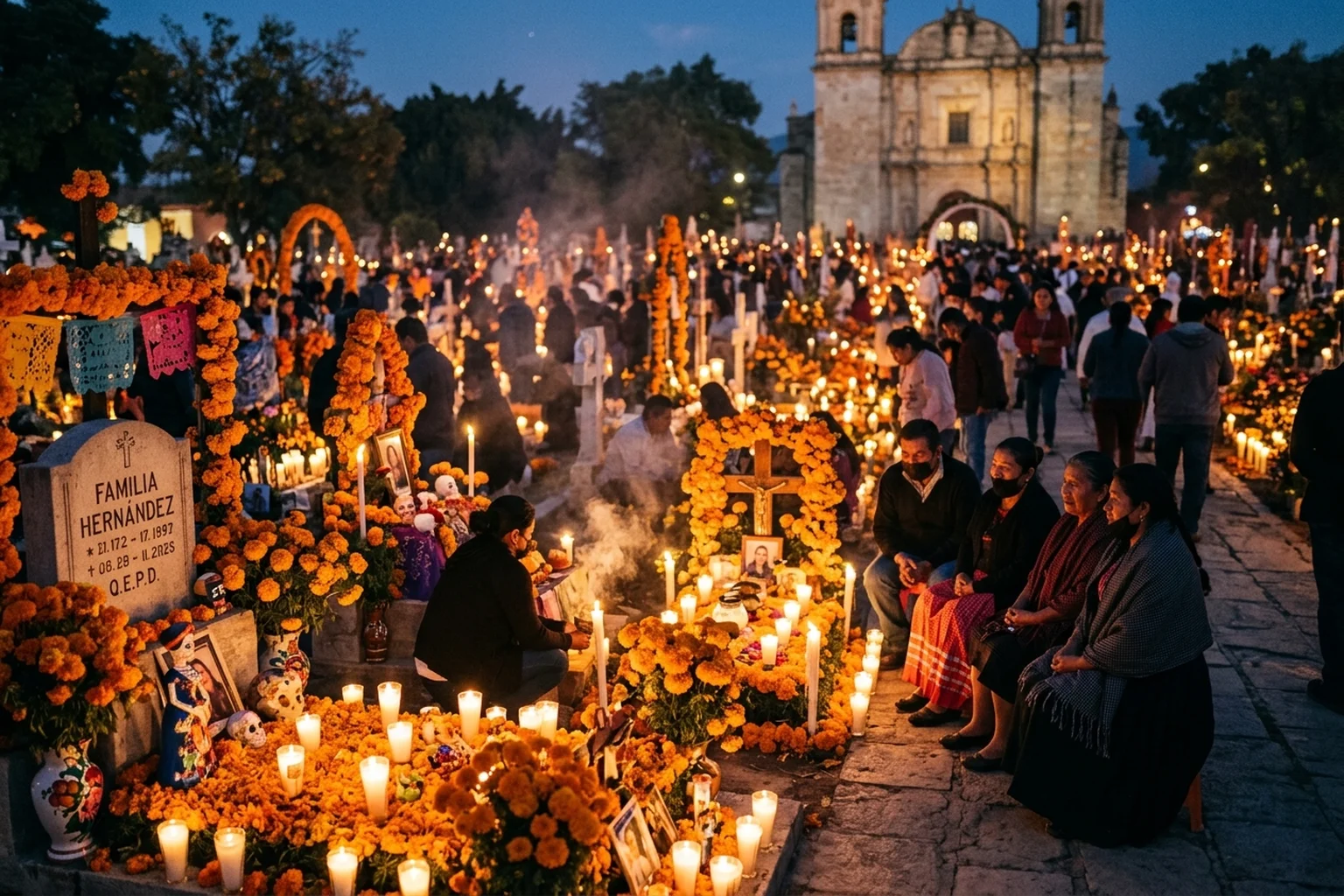
The giant Day of the Dead parade down Paseo de la Reforma, the one with the skull floats and the thousand costumed dancers, did not exist before 2016.
It exists because of a James Bond film. Spectre opened in 2015 with an eight-minute sequence set at a Day of the Dead parade in Mexico City. The parade was fictional. The city watched several hundred million people come away believing it was real, and staged one. The first Gran Desfile ran on 29 October 2016 and drew an estimated 425,000 people.
Atlas Obscura put it flatly at the time. “There are many traditions across Mexico that are associated with Day of the Dead, but a parade through downtown Mexico City has never been one of them.”
None of which makes it bad. It is free, it is enormous, it is genuinely good fun, and after ten editions it is becoming a tradition in its own right. It just is not the old thing, and if the old thing is what you booked a flight for, you are in the wrong city.
The short answer
- Día de Muertos is 1–2 November. The Mexico City parade is Saturday 31 October 2026, and it is free.
- The parade dates from 2016 and was staged after the Bond film Spectre invented one.
- The centuries-old version is the all-night cemetery vigil, and it happens in Oaxaca and Michoacán.
- Michoacán, which contains Janitzio, is a Level 4 "do not travel" state. Oaxaca is Level 2.
What the tourism secretary actually said
The parade was not a cultural project. Mexico City’s then tourism secretary, Miguel Torruco Marqués, was explicit about the reasoning while the film was still shooting in April 2015.
“Bond Cities start booming as soon as the movie comes out. Not only in tourism, but also in investment. There will be a huge economic boom.”
Tourism authorities described the event in their own press material as a Spectre-style parade. The first edition ran more than a thousand performers, dozens of floats and giant sculptures.
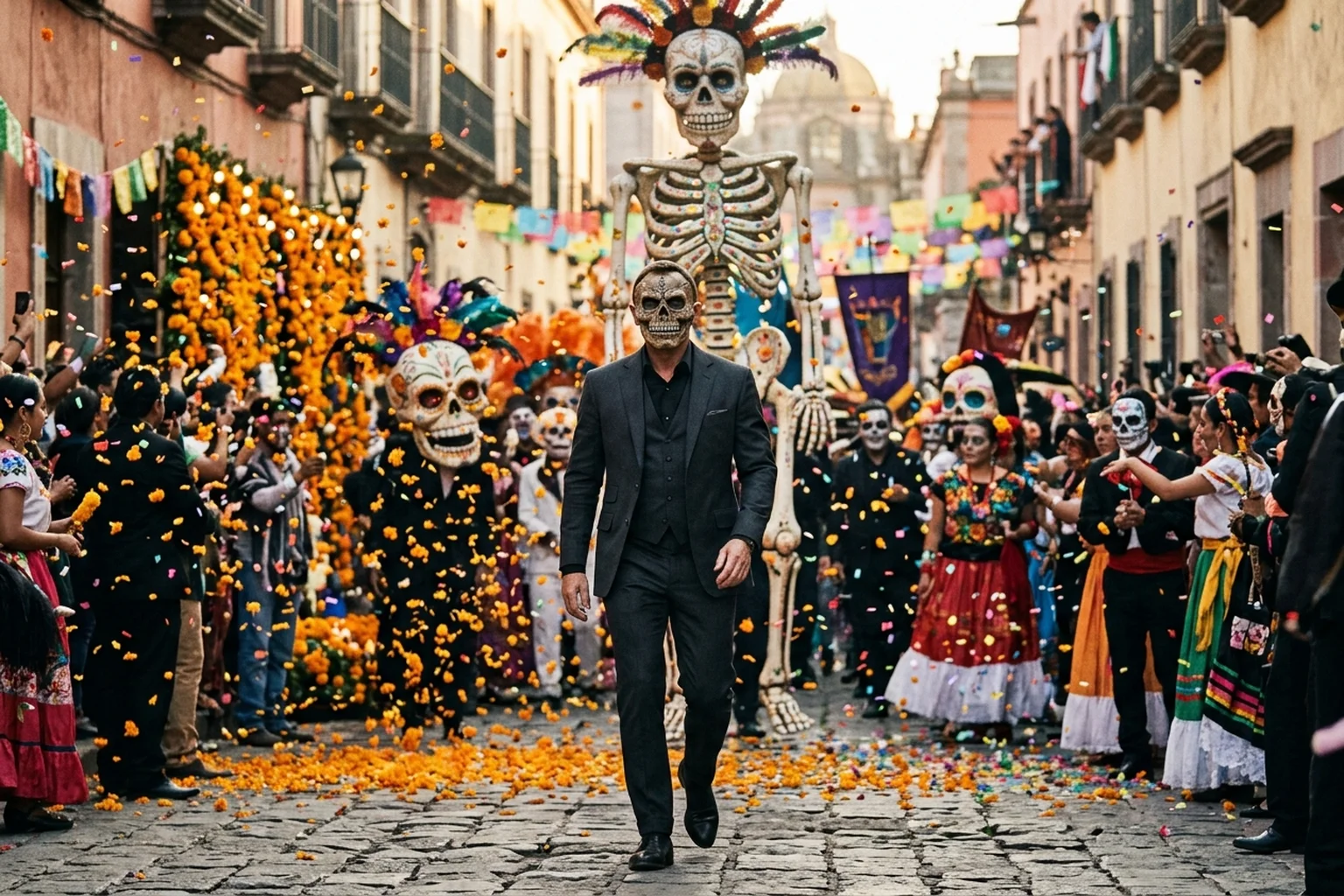
It worked. That is the part worth sitting with. A film invented a tradition, a city built the tradition to match the film, and a decade later hundreds of thousands of people turn out for something that is now real because enough people showed up.
The 2026 calendar
| When | Where | What |
|---|---|---|
| Sat 31 Oct | Mexico City | Gran Desfile, Chapultepec to the Zócalo, around 2pm |
| 31 Oct – 2 Nov | Oaxaca | Comparsas, sand tapestries, cemetery vigils |
| Sun 1 Nov | Everywhere | Día de los Angelitos, for children who have died |
| Night of 1 Nov | Janitzio, Michoacán | Candlelit canoe procession and all-night vigil |
| Mon 2 Nov | Everywhere | Día de Muertos proper, for adults |
| 1–2 Nov | Mixquic, Mexico City | Candlelit cemetery vigils inside the city |
One honesty note on that first row. El Informador reported the 31 October date on 17 August, but said the definitive start time and route were still awaiting official confirmation. The city’s own culture page currently shows only the call for participants rather than public details. The date looks solid. Do not book a restaurant at 1pm on the strength of the 2pm start.
Oaxaca, where almost everything is free
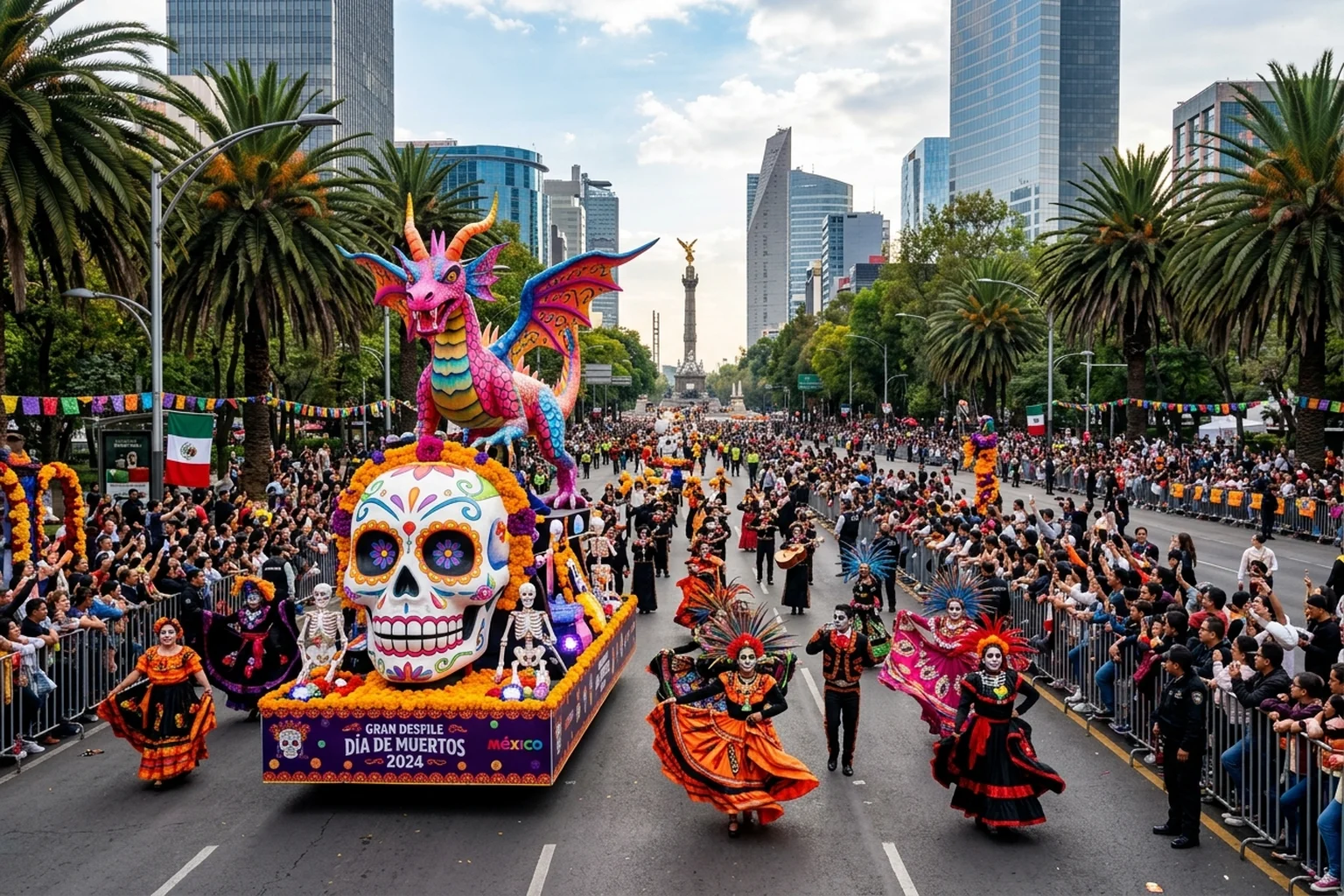
Oaxaca is the answer for most people. The comparsas, which are neighbourhood processions with brass bands and costumes, are free public events running across several days. The 2026 schedule includes the Candiani comparsa on 30 October at 7pm, Cinco Señores at 3pm and Jalatlaco around 8pm on 1 November, and Barrios Unidos at 4pm on 2 November.
The cemetery vigils are the heart of it. Xoxocotlán is the famous one, where families gather through the night with flowers, candles and music. Panteón General San Miguel in the city itself is the other.
There is one paid exception, and it is an interesting one. San Agustín Etla, known for its muerteadas, has started closing the town entrances around 7pm on 1 November, suspending alcohol sales around 11pm, and charging outside visitors who arrive in costume or face paint. A town that got tired of being a backdrop decided to price the backdrop. Check before you turn up painted.
Every travel scam runs on the same fuel: you don’t know what normal looks like, so a fake fee looks like a real one. That’s the whole reason I built Good Trip — scam warnings for Mexico and 25 other countries, offline, free, no account, no data collected.
Janitzio, and the advisory nobody mentions
The image most people have of a truly traditional Day of the Dead is Janitzio, an island in Lake Pátzcuaro in Michoacán. Boats run from the Pátzcuaro pier more or less continuously through the night of 1 November, candlelit canoes cross the water, and families keep vigil in the island cemetery until dawn. Fog sometimes stops the boats.
Here is what almost no travel guide says alongside that picture.
Michoacán is a Level 4 state. The US State Department advisory reads “do not travel due to crime and kidnapping.” It is the same level given to Afghanistan and Syria. The advisory carves out specific exceptions for US government employees, naming Federal Highway 15D for transit, Morelia by air or via Highways 43 and 48D, and Lázaro Cárdenas by air only. Pátzcuaro is not named in any of them.
By contrast, Mexico City and Oaxaca state are both Level 2, exercise increased caution, the same level the State Department gives France, Italy and Türkiye. Mexico as a whole sits at Level 3.
That is information, not instruction. Pátzcuaro receives very large numbers of Mexican visitors every year and the advisory describes a state, not a town square. Our guide to reading travel advisories covers why a state-level rating often reflects places hundreds of kilometres from the one you are going to, and why Level 4 is not a prediction about your week. But you should make that call knowing the number exists, because the photo essays will not tell you.
How to behave in a cemetery
These are working graves and grieving families, not a set. Oaxaca’s own visitor guidance is direct about it.
- Do not touch altars, flowers, candles, photographs or food offerings. Every item on an ofrenda was chosen for one person.
- Do not sit, lean or put bags on tombs.
- Ask before photographing people or private graves, and turn the flash off.
- Keep your voice down, and do not smoke.
- Face paint is welcome at public events. Mocking the altars is not.
The distinction that matters is that the parade is a performance and the cemetery is not. The same costume is fine in one and questionable in the other.
The short version
| Do this | Why |
|---|---|
| Want the spectacle? Mexico City, 31 October | Free, huge, and ten years old |
| Want the tradition? Oaxaca, 31 Oct to 2 Nov | Free comparsas and the Xoxocotlán vigils |
| Check the parade time before booking around it | Date confirmed, time and route were not |
| Read the Michoacán advisory before choosing Janitzio | Level 4, and Pátzcuaro has no carve-out |
| Buy no parade tickets | It is a street parade. There is no ticket. |
| Skip the face paint in San Agustín Etla | They now charge costumed outside visitors |
| Touch nothing on an ofrenda | Every object on it belongs to one dead person |
| Pack layers for Janitzio or Xoxo | You are outdoors from dusk to dawn |
Before you fly
The moment that costs you is the one where you have flown to Mexico City for the thing you saw in a photograph, the parade has been over for six hours, and you are trying to work out on airport Wi-Fi whether the cemetery you actually wanted is a three-hour bus ride or a three-flight day, and whether the state it sits in is one your government has told you not to enter.
That’s why I built Good Trip. It’s a free app with destination-specific scam warnings, an offline phrasebook, a currency converter, local emergency numbers, and step-by-step eSIM setup, for Mexico and 25 other countries. All of it works offline, so it still works standing in a cemetery in Oaxaca at two in the morning with no signal.
No account. No data collected.
Download it before you fly, not after you’ve crossed the country for a parade that a film invented in 2016.
Sources: Atlas Obscura: Mexico City's new Day of the Dead parade is based on a James Bond film , US State Department Mexico Travel Advisory, state-by-state levels , El Informador: confirmed date for the 2026 Mexico City parade , Mexico City Secretaría de Cultura: Gran Desfile de Día de Muertos 2026 , Day of the Dead 2026 in Oaxaca: dates, comparsas and cemetery guidance , Janitzio Day of the Dead: island vigil and traditions , Día de Muertos 2026 in Mexico City: parade, ofrendas and crowds .
Good Trip keeps local etiquette, scam warnings, emergency numbers, offline phrasebooks, and currency conversion on your phone. Download it before you fly.
Good Trip works 100% offline.
Curated culture tips, phrasebooks, scam warnings, and emergency data for Japan, Korea, Vietnam, Mexico, and 22 other countries.
Get Good Trip on the App Store →