EES Airport Survival Guide: How Early to Arrive
How long the lines really are, and how early to actually arrive
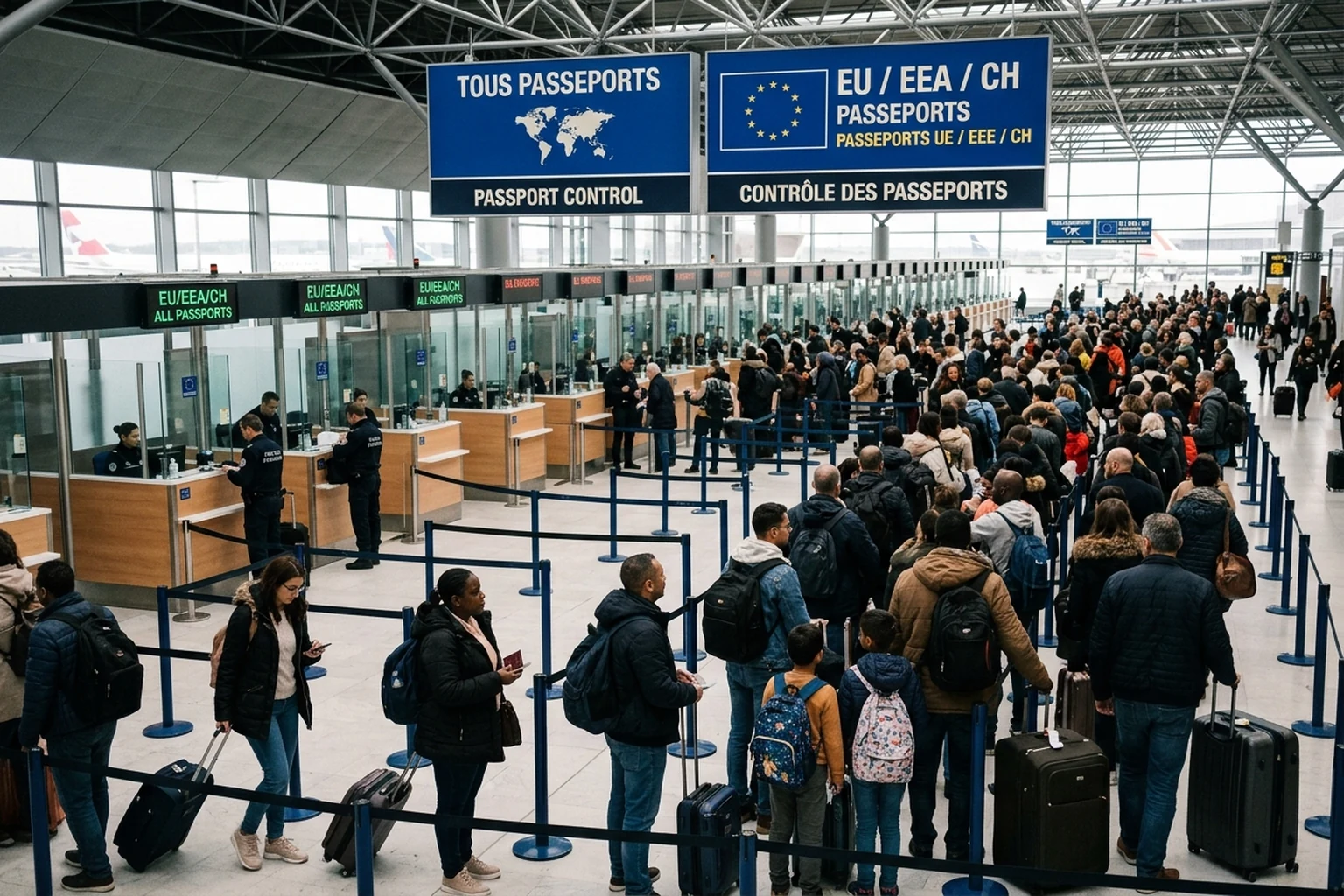
If you’re flying to Europe between now and the holidays, one number matters more than your seat assignment: how much buffer you leave at the border.
Europe’s Entry/Exit System has been fully live since April 10, 2026, and the first summer under it has been rough. Peak queues at some of the busiest hubs have roughly doubled year over year. Aviation trade groups have called the situation critical. Flights have left Europe with dozens of empty seats belonging to people still standing in a passport line downstairs.
But the panic coverage has been misleading in one specific way, and it’s costing travelers money: the scary numbers are peak numbers, not typical ones. Most people clear the border in a fraction of the headline time. The trick is knowing which trips put you in the bad tail — and restructuring those, rather than losing sleep over all of them.
Here’s the playbook.
New to all this? This guide assumes you know what the EES actually is. If you don’t, start there and come back.
What the wait times actually are
The most credible dataset so far comes from a Financial Times analysis of queue data from travel analytics firm Qsensor, comparing July 2026 with July 2025:
Read the column headers carefully, because almost every outlet that covered this got the framing wrong. These are maximum recorded queue times at peak — not what a typical passenger experiences.
The same Qsensor data found that at Schiphol, roughly two-thirds of travelers were processed in under 15 minutes, and the average July wait was around 12 minutes. The European Commission’s own figure for a completed EES check is about 70 seconds. Off-peak, the big hubs have been clearing people in 10 to 20 minutes.
So both things are true at once: most crossings are fine, and the bad ones are genuinely awful.
The worst documented cases are much uglier than the table above. IATA’s Europe vice president has described waits running three, four, five, even six hours, calling them unacceptable. In a July 1 open letter to European Commission President Ursula von der Leyen, ACI Europe, Airlines for Europe and IATA said the rollout had reached a critical point and cited waits of up to five hours. Brussels Airport reported roughly 600 missed flights over four days. An easyJet departure from Milan Linate to Manchester left with 122 ticketed passengers still stuck at passport control.
The Commission’s counter-argument is worth knowing, because it’s the key to planning: it has identified roughly 20 of about 1,500 border crossing points as seriously affected. This is a concentrated problem, not a continent-wide one.
What that means for you: the risk isn’t “Europe.” The risk is a specific airport, at a specific hour, on a specific day.
The airports where you need to be careful
There is no live, verified EES queue feed anywhere — treat any site promising you real-time minute-by-minute waits with suspicion. But based on consistent incident reporting through spring and summer 2026, these are the pressure points:
Highest risk: Paris CDG (especially Terminal 2E on the mid-afternoon long-haul arrival bank), Amsterdam Schiphol (morning arrival waves), Frankfurt, Brussels, Lisbon, Porto, Milan, Athens, Madrid, Barcelona.
Structural reason it’s these: they take large volumes of non-EU long-haul arrivals in tight banks, which is exactly the traffic pattern EES handles worst. CDG’s Terminal 2E has been reported processing well below its forecast throughput since April.
Lower risk: smaller regional entry points, and airports where most arrivals are intra-Schengen.
Not affected at all: Ireland and Cyprus are outside the EES and still stamp passports by hand. If your itinerary is flexible, an Irish entry point sidesteps the whole thing.
Before you fly, check your specific airport’s own website and app. Groupe ADP (Paris), Schiphol, Fraport and others publish operational advisories, and those are more reliable than any aggregator.
Your first entry is the slow one. After that it gets better.
This is the single most reassuring fact in this guide, and it’s underreported.
The queue isn’t caused by the routine check. It’s caused by first-time enrollment — capturing four fingerprints, a facial image, and your passport data, one traveler at a time.
Once you’re enrolled, you’re on file for three years from your last border crossing. Subsequent entries are a much faster verification against the record that already exists, and at many airports you can use e-gates you weren’t eligible for on your first pass.
So if you’re going to Europe twice in the next eighteen months, the first trip carries almost all of the pain. Plan generously for it, and plan closer to normal for the second.
Two caveats:
Enrollments have failed and had to be redone. Travelers have reported being fingerprinted on multiple trips because of glitches. Don’t treat “I’m already in the system” as a guarantee of a fast lane.
If you overstay or are refused entry, your record can be held for up to five years.
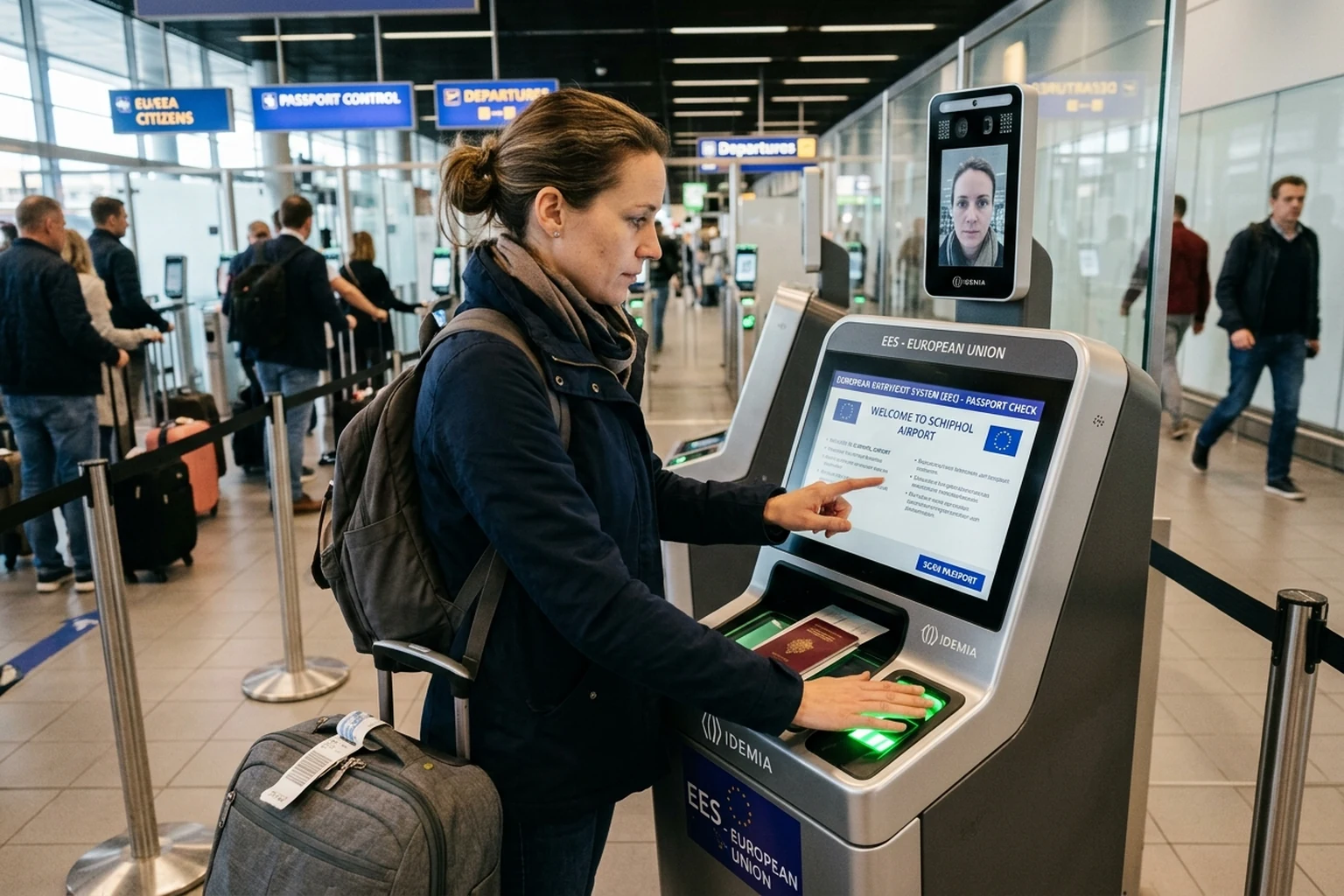
Here’s the piece most coverage is burying, and the reason this is worth reading in August rather than October.
Airports have been coping this summer using a legal escape hatch. Under Regulation (EU) 2025/1534, member states can temporarily pause biometric collection at a specific crossing point — up to six hours at a time, renewable — when queues become unmanageable. Entry and exit still get logged; only the fingerprint capture is skipped. Several countries have leaned on this heavily, including at French, Dutch, German, Belgian, Portuguese and Italian airports.
That mechanism is scheduled to expire on September 6, 2026.
On July 7, nine governments — Belgium, France, Germany, Greece, Italy, Malta, the Netherlands, Portugal and Switzerland — jointly asked Brussels to extend it, calling the expiry a serious concern. Separately, the airline and airport lobby asked for a full summer suspension; the Commission refused, saying it was neither possible nor necessary.
As of this writing, no formal extension has been announced. Reporting in The Times suggests EU Transport Commissioner Apostolos Tzitzikostas has privately signaled that some flexibility is likely to continue, and the Financial Times and others have reported similar. But privately signaled is not decided, and the September 6 date legally stands.
What to do with this: if you’re flying in the second half of September, October or November, build your buffer as though the safety valve is gone. If it gets extended, you’ve lost nothing. If it doesn’t, the airports currently switching biometrics off at peak will have to stop doing that — during autumn half-term and the run-up to the holidays.
One more thing worth knowing, because it trips people up: a paused fingerprint scan does not pause your 90-days-in-180 clock. Your entry and exit still land in the central database. A quiet border day is not free time in the Schengen area.
The new connection math
If you take one action item from this guide, make it this one.
Stop booking 90-minute connections through a Schengen hub as your first European touchpoint. A layover that worked fine in 2024 is now a coin flip.
The rule that governs everything: EES happens at your first Schengen entry point, not your final destination.
New York → Paris → Rome: you clear EES in Paris. Paris–Rome is an internal Schengen flight.
Chicago → London → Barcelona: you clear EES in Barcelona. The UK isn’t in Schengen.
Boston → Frankfurt → Istanbul, staying airside the entire time: no EES at all. International-to-international transit without clearing passport control doesn’t trigger it.
That third case has a trap in it. If you need to collect checked bags, change terminals, or check in for a separately ticketed flight, you’ve left the transit zone — and you’re now in the EES queue.
Working buffers, based on what airlines and airports are themselves recommending:
Yes, the exit check catches people too. EES verifies you on the way out, which is why passengers have been missing flights home, not just onward connections. Departure-side waits at Brussels have run around two hours; arrivals over three.
The pre-registration app: real, free, and probably useless to you
There is an official app. It’s called Travel to Europe, it was built by Frontex, it costs nothing, and it’s in the Apple App Store and Google Play.
It is also far narrower than most travelers assume. As of August 2026:
It works for Sweden (full pre-registration: passport data, facial image, entry questionnaire) and Portugal (the questionnaire only).
France, the Netherlands and Italy are running pilots that aren’t open to the public. Greece and Hungary have expressed interest. Nobody else is live.
You need a biometric passport — the one with the chip symbol on the cover. The app reads the chip.
You submit within 72 hours of travel. Passport data and facial image in the app expire after seven days.
It does not skip the queue. Fingerprints can only be taken in person by a border guard. Pre-registration shortens your own transaction, not the line in front of you. Sweden’s Arlanda trial measured roughly a 25% efficiency improvement in the procedure itself.
So: if you’re landing in Stockholm or Lisbon, spend the five minutes. Everywhere else, ignore it — and be suspicious of anyone telling you otherwise, which brings us to the next section.
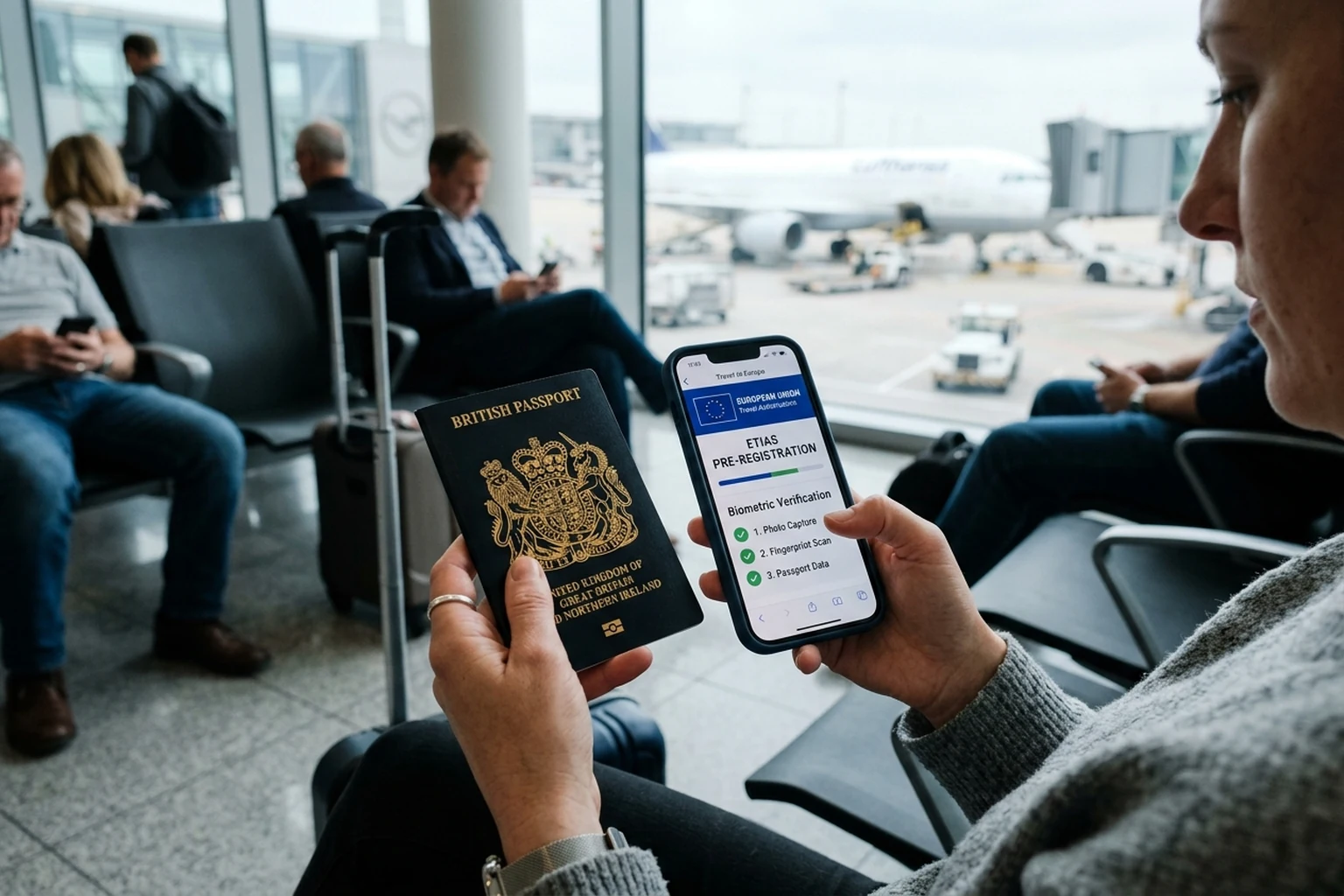
EES has no application, no form, no fee, and no fast-track. It happens at the border, it’s free, and there is nothing to buy in advance.
If a website offers you “EES registration,” “EES pre-approval,” “expedited EES processing,” or a “European entry permit,” it is a scam. Full stop.
The scammers are exploiting the confusion between EES and ETIAS. ABTA has flagged more than 60 fake sites purporting to sell ETIAS authorizations — a system that isn’t live yet and that you cannot apply for today. Some of these sites have charged well over €100 for a document that will eventually cost €20 from the EU directly. Others simply harvest passport numbers and card details.
Your rules:
There is nothing to apply for or pay for right now. Not EES. Not ETIAS.
The only free tool that exists is the Travel to Europe app, from official app stores only.
When ETIAS launches, it will be sold on the official EU site and nowhere else.
Airport fast-track lanes sold by airports and concierge services are a separate, legitimate product — but they get you to the front of the line faster, they don’t shorten the biometric enrollment itself.
Every travel scam runs on the same fuel: you don’t know what normal looks like, so a fake fee looks like a real one. That’s the whole reason I built Good Trip — scam warnings for 17 countries, offline, free, no account, no data collected.
Traveling with kids
The rules are more forgiving than parents expect, but the logistics are less so.
Under 12: no fingerprints. Children in this age group are exempt from fingerprint capture under the EES regulation.
But they are still registered. A facial image and passport data go into the system regardless of age, including for infants.
Every child needs their own travel document. If a child appears only on a parent’s passport with no individual document, EES registration isn’t possible. Check this now, not at the airport.
Register as a group. Go to one desk together rather than splitting across lanes — the officer processes the family in one session.
Family lanes exist at most large airports (CDG, FRA, AMS, FCO, MAD, BCN). Follow the signs or ask at an information desk; they can bypass the main kiosk queue.
Unaccompanied minors generally can’t use self-service pre-registration kiosks and will be processed at a staffed booth.
Practical note: the facial capture means hats, sunglasses and masks come off briefly. Warm kids up on that before you’re at the front of the line with a tired four-year-old.
If the border makes you miss your flight
This is where the money is, and where the advice online is worst.
The one decision that matters is one ticket versus two.
On a single ticket (through-ticket): you’re a misconnect. In practice, carriers have been rebooking passengers onto the next available flight, and if a reroute leaves you overnight you should be asking for meals and accommodation. Be aware that the legal position is murkier than it is for an airline-caused delay — some analysts argue a queue-caused miss is technically a no-show, which carries no statutory duty to rebook. Many airlines have been rebooking as goodwill rather than obligation. Ask politely, ask early, and don’t assume the counter agent knows the distinction.
On separate tickets (self-transfer): the second airline owes you nothing. Your missed leg is a no-show and your ticket is likely worthless. This is the single most expensive mistake available under EES, and it’s entirely avoidable at booking time.
Cash compensation under EU261 almost never applies. EU261 pays out when the airline causes your delay. Border processing is a government function outside the carrier’s control, so the flight operated on schedule and you weren’t at the gate. No cancellation, no long delay, no denied boarding — nothing for the regulation to attach to. Claims companies advertising EES compensation are, at best, overselling.
What actually helps:
Say something while you’re still in the queue. Travelers have reported being escorted forward when they showed a boarding pass with a closing gate time. Find a staff member, be polite, show the pass.
Call the airline from the line, not from the counter after. Hold times are shorter and you may be rebooked before you reach the front.
Check your travel insurance for missed-connection cover — and read whether it names border or immigration delay as a covered cause. Many policies require a minimum delay and a specific list of causes, and “passport control was slow” isn’t always on it.
Check your credit card’s trip delay protection, which sometimes covers hotel and meals where insurance won’t.
Photograph the queue with a timestamp. Any claim you file will need evidence, and “I waited three hours” is not evidence.
What’s coming next: ETIAS
ETIAS — the €20 pre-travel authorization for visa-exempt travelers — was supposed to arrive in late 2026. It hasn’t, and the timeline has now gone soft.
The EU has removed the Q4 2026 target from its official site and says it will announce a date several months before launch. Financial Times reporting points to 2027, with one person briefed on the discussions calling a 2026 launch illusory. eu-LISA’s management board is expected to meet in September 2026 to set a revised timeline. Industry chatter suggests April 2027 as an early realistic date, though nothing is confirmed.
When it does arrive, expect a phased transition rather than a hard switch, with the fee waived for under-18s and over-70s and the authorization valid for three years or until your passport expires.
For now: there is nothing to do, and nothing to buy. See our ETIAS explainer for the full picture.
The five-line version
- Peak waits at the worst hubs have doubled; typical waits have not. The risk is concentrated, not universal.
- Your first entry is the slow one — you're on file for three years afterward.
- Three hours is the new buffer: for connections at your first Schengen airport, and for departures out of Schengen.
- Book one ticket, not two. It's the difference between a rebooking and a rebuy.
- Nobody can sell you EES registration. It's free, it's at the border, and there's no form.
Before you fly
Here’s the thing about the EES queue: it’s the exact moment your phone is least useful. You’ve landed, you’re an hour into a line that isn’t moving, your eSIM isn’t live yet, and the airport WiFi wants an email address before it’ll let you look up your airline’s number.
That’s why I built Good Trip. It’s a free app with destination-specific scam warnings, an offline phrasebook, a currency converter, local emergency numbers, and step-by-step eSIM setup — for France, Germany, Italy, Spain, Portugal, the Netherlands, Ireland and the UK, plus nine more countries. All of it works offline, so it’s already there in the arrivals hall before you have a single bar of signal.
No account. No data collected. Download it before you fly — not while you’re watching your connection board without you.
Sources
- Financial Times / Qsensor July 2026 queue analysis, as reported by Euronews, The Local and DutchReview
- ACI Europe / A4E / IATA open letter to the European Commission, July 1, 2026
- Connexion France on the September 6 flexibility question
- Biometric Update on the nine-country joint letter and Commission response
- Frontex on the Travel to Europe pre-registration app
- The Local on which countries have activated the app
- Euronews / ABTA on ETIAS scam sites
- AFAR on the ETIAS delay
- Euronews on missed connections and passenger rights
- AirHelp on EC261 and border-caused delays
- Berlin Brandenburg Airport and French Ministry of the Interior guidance on minors and pre-registration devices EES rules and flexibility arrangements are changing quickly — verify time-sensitive details with your airline and airport before travel.
Take Good Trip offline.
Culture tips, phrasebooks, scam warnings, and emergency data for Japan, Korea, Vietnam, Mexico, and 26 other countries.
Get Good Trip on the App Store →