Egypt Visa Fees: Five Prices for the Same Entry, and One Is Free
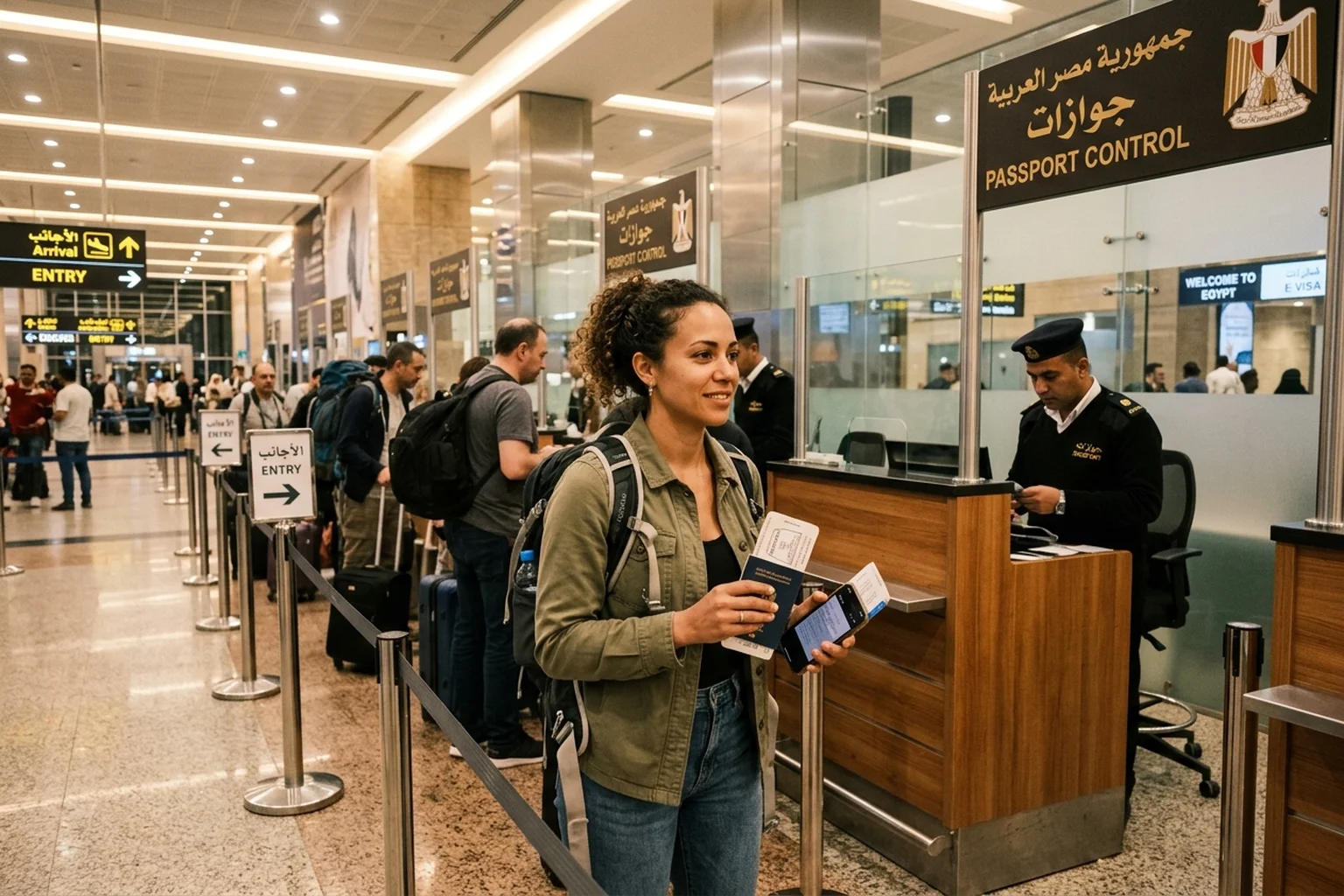
Egypt has five different prices for letting you through passport control. They run from nothing to $65, and which one you pay depends on where you land, what you sorted before you flew, and whether anybody mentioned that the free option exists.
Most people never hear about the free one. It covers Sharm El Sheikh, Dahab and the whole Red Sea coast of Sinai, it takes under two minutes at the desk, and if your trip is a diving week it is the only thing you need.
Two things also changed this year, both quietly. The e-visa went up on 27 April, and Cairo started issuing a digital visa with a QR code on 1 August. That code expires faster than most people will expect.
The short answer
- Going only to Sharm, Dahab, Taba or St Catherine's? The Sinai permit is free at the airport. Buy nothing.
- Going to Cairo, Luxor or Hurghada? You need a real visa. The e-visa is $30 at visa2egypt.gov.eg, the only official site.
- Cairo's new QR visa on arrival is $36, which is $6 more than doing it online beforehand.
- The QR code is reported to last 48 hours. Generate it close to departure, not weeks ahead.
The five prices
| What you get | Cost | Where |
|---|---|---|
| Sinai-only permit | Free | Sharm El Sheikh and Taba airports, Sinai only |
| e-Visa, single entry | $30 | Online at visa2egypt.gov.eg, before you fly |
| Visa on arrival, paper sticker | $30 | Hurghada, Sharm, Luxor and most airports |
| Visa on arrival, digital QR | $36 | Cairo only, since 1 August 2026 |
| e-Visa, multiple entry | $65 | Online, before you fly |
Read that top row and the bottom row together. The same country, the same passport, and a $65 spread. Nothing about the process tells you which row you are standing in.
The free one, and who it is actually for
The Sinai-only permit is issued free at Sharm El Sheikh and Taba, processed digitally, and done in under two minutes. It covers Sharm El Sheikh, Dahab, Nuweiba, Taba and St Catherine’s Monastery. Ras Muhammad National Park is generally included for land visits, though boat dives may need separate authorisation.
It does not cover Cairo, Luxor, Hurghada, or the Thistlegorm wreck dives. The permit stops being valid the moment you leave the peninsula, so a day trip to the pyramids is not a grey area. It is an upgrade, bought at an airport bank kiosk or a passport office in Sharm.
Be careful with the duration, because the sources do not agree. Kadmar Travel puts the permit at 15 days. The US State Department, describing the version issued at Taba to travellers arriving from Israel, calls it a free, 14-day permit valid only in Sinai. Nobody explains the gap. Plan on 14 and you are safe either way.
One more caution. Several Sinai guides still quote $25 as the upgrade price for a full tourist visa. That was correct until 27 April 2026 and it is now $30. If a page is still printing $25, it has not been touched since spring, and you should not trust its other numbers either.
What changed in 2026
27 April. The e-visa rose from $25 to $30 single-entry, and from $60 to $65 multiple-entry.
1 August. Cairo International began a digital visa-on-arrival pilot. The fee is $36, being the existing $30 plus a $6 issuance charge for the QR code. Payment runs through the portal via National Bank of Egypt or Banque Misr, and officers scan the code off your phone or a printout.
Three things about that pilot are easy to get wrong:
- It is Cairo only. Hurghada, Sharm El Sheikh and Luxor are still issuing paper stickers.
- Paper stickers still run in parallel at Cairo too, with no announced end date.
- The code is reported to last 48 hours. Wego’s reporting on the pilot says each code is valid for only that long, so generating one a fortnight ahead like a normal e-visa leaves you with a dead code at the desk.
The $6 gap is the part worth acting on. Doing it online beforehand is cheaper than doing it on arrival, which inverts the usual assumption that the airport option costs you time rather than money.
The official site, and the ones that are not
Egypt’s only official e-visa portal is visa2egypt.gov.eg. It ends in .gov.eg, which is the tell, exactly as .go.th is the tell in our Thailand arrival card guide. Anything ending .com or .org, however many seals it carries, is a commercial operator adding a margin to a $30 government fee.
The same rules apply as anywhere:
- Navigate from the domain, not from the search result. Sponsored placement is bought, not earned.
- A fee range is a sales funnel. Governments have one price.
- Read the footer. Most resellers admit somewhere that they are not the government.
Every travel scam runs on the same fuel: you don’t know what normal looks like, so a fake fee looks like a real one. That’s the whole reason I built Good Trip — scam warnings for Egypt and 25 other countries, offline, free, no account, no data collected.
What you pay once you are inside
The Grand Egyptian Museum publishes its rates openly, and they are steep by any measure.
| Visitor | Adult | Student or child |
|---|---|---|
| Egyptian citizens | LE350 | LE175 |
| Foreign residents of Egypt | LE850 | LE425 |
| Foreign visitors | LE1,700 | LE850 |
At the 11 September 2026 rate of about 51.36 pounds to the dollar, LE1,700 is roughly $33, against about $7 for an Egyptian. That is a factor of just under five. Book through the official site rather than a reseller.
At the pyramids
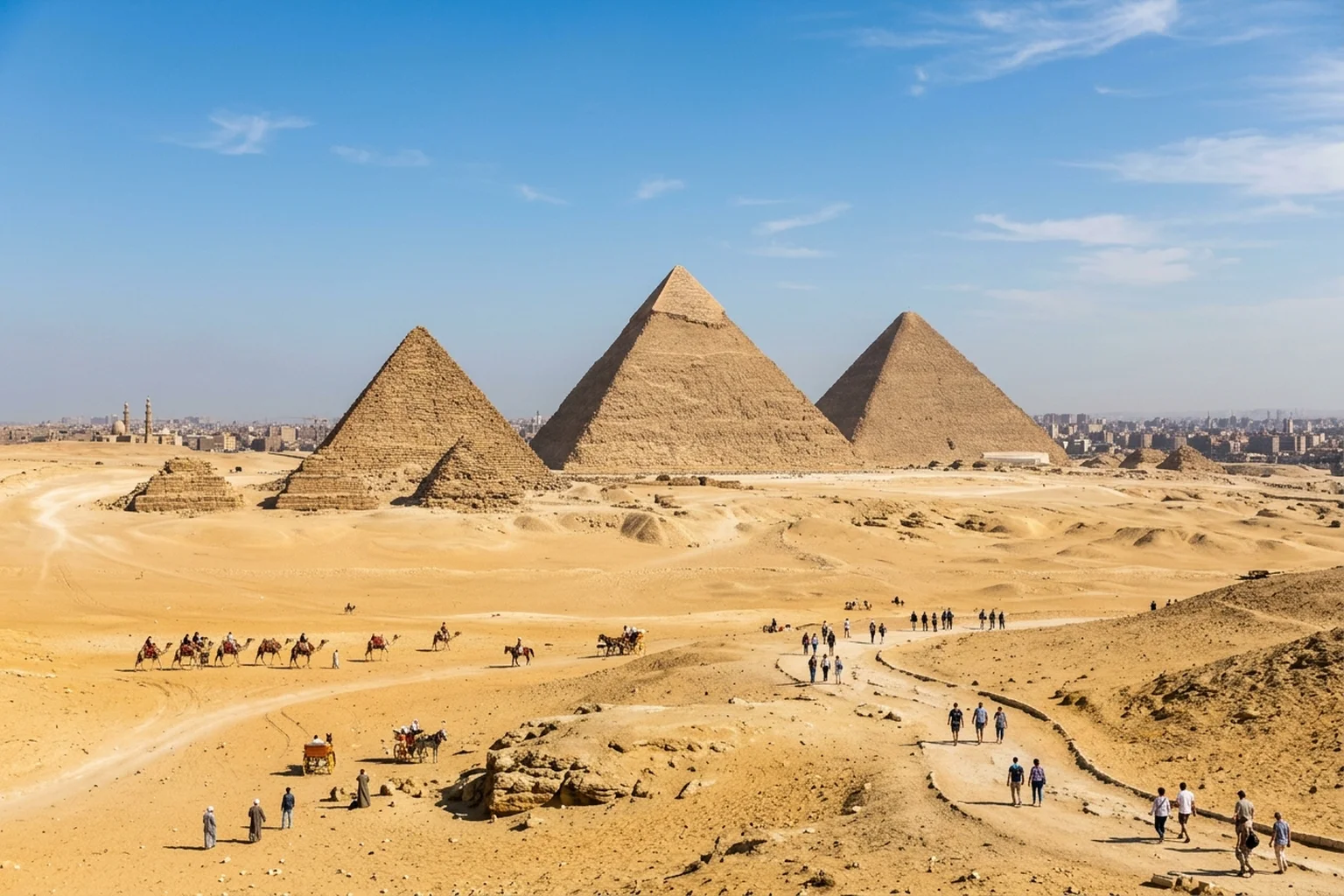
Giza runs on a handful of scams that have barely changed in decades, and all of them work the same way. Something happens before a price is agreed.
- The man who greets you at the gate. He calls himself an official guide, a site manager, or tourism police. Bills of $50 to $100 or more arrive at the end. Real guides do not recruit at the entrance.
- The camel price that was per person all along. A handler quotes a figure, then explains after you are up that it was each, or one-way. Some will not let you down. Agree the total, in writing on a phone screen, for the round trip, for everyone, before anyone mounts anything.
- The gift placed in your hand. A papyrus, a scarab, a scarf, described as a gift until you are holding it. Keep your hands down.
- The animal that wanders into your photo. Then a fee for having been in it.
- The discounted ticket outside the gate. Buy at the official ticket office at the main gate or with an official online QR ticket, and nowhere else.
The State Department lists Egypt at Level 2, exercise increased caution, issued 15 July 2025. That is the same level it gives France and Italy, and our guide to reading advisories covers why the headline number tells you the least.
The short version
| Do this | Why |
|---|---|
| Red Sea only? Take the free Sinai permit | Covers Sharm, Dahab, Nuweiba, Taba, St Catherine’s |
| Cairo or Luxor? Buy the e-visa online first | $30 online against $36 on arrival at Cairo |
| Use visa2egypt.gov.eg and nothing else | The .gov.eg ending is the tell |
| Generate a QR code close to departure | Reported 48-hour validity |
| Plan on 14 days for the Sinai permit | Sources say 14 and 15, nobody explains why |
| Ignore any page still quoting $25 | That price died on 27 April 2026 |
| Agree camel and guide prices before, in total | Round trip, per group, written down |
| Carry 6 months passport validity and a blank page | Both are State Department requirements |
Before you fly
The moment that costs you is at the Sharm El Sheikh arrivals desk, jet-lagged, with a queue behind you, when someone points you at the bank window to buy a visa. You are going diving. You are not leaving Sinai all week. The thing you actually need is free and takes ninety seconds, and nobody in that hall has any reason to tell you so.
That’s why I built Good Trip. It’s a free app with destination-specific scam warnings, an offline phrasebook, a currency converter, local emergency numbers, and step-by-step eSIM setup, for Egypt and 25 other countries. All of it works offline, so it still works in the arrivals hall before you have signal.
No account. No data collected.
Download it before you fly, not after you’ve paid $30 for a permit that was free.
Sources: US State Department: Egypt International Travel Information , Egypt official e-visa portal , Egypt increases tourist e-visa fees for 2026 , Egypt's visa on arrival goes digital at Cairo Airport from August 2026 , Sinai-only visa 2026: requirements and coverage , Grand Egyptian Museum full ticket price list , Giza pyramids scams and safety, 2026 , USD to EGP exchange rate, September 2026 .
Good Trip keeps local etiquette, scam warnings, emergency numbers, offline phrasebooks, and currency conversion on your phone. Download it before you fly.
Good Trip works 100% offline.
Curated culture tips, phrasebooks, scam warnings, and emergency data for Japan, Korea, Vietnam, Mexico, and 22 other countries.
Get Good Trip on the App Store →