German Christmas Markets 2026: Dates, the Pfand System, and Why Pickpockets Love Glühwein
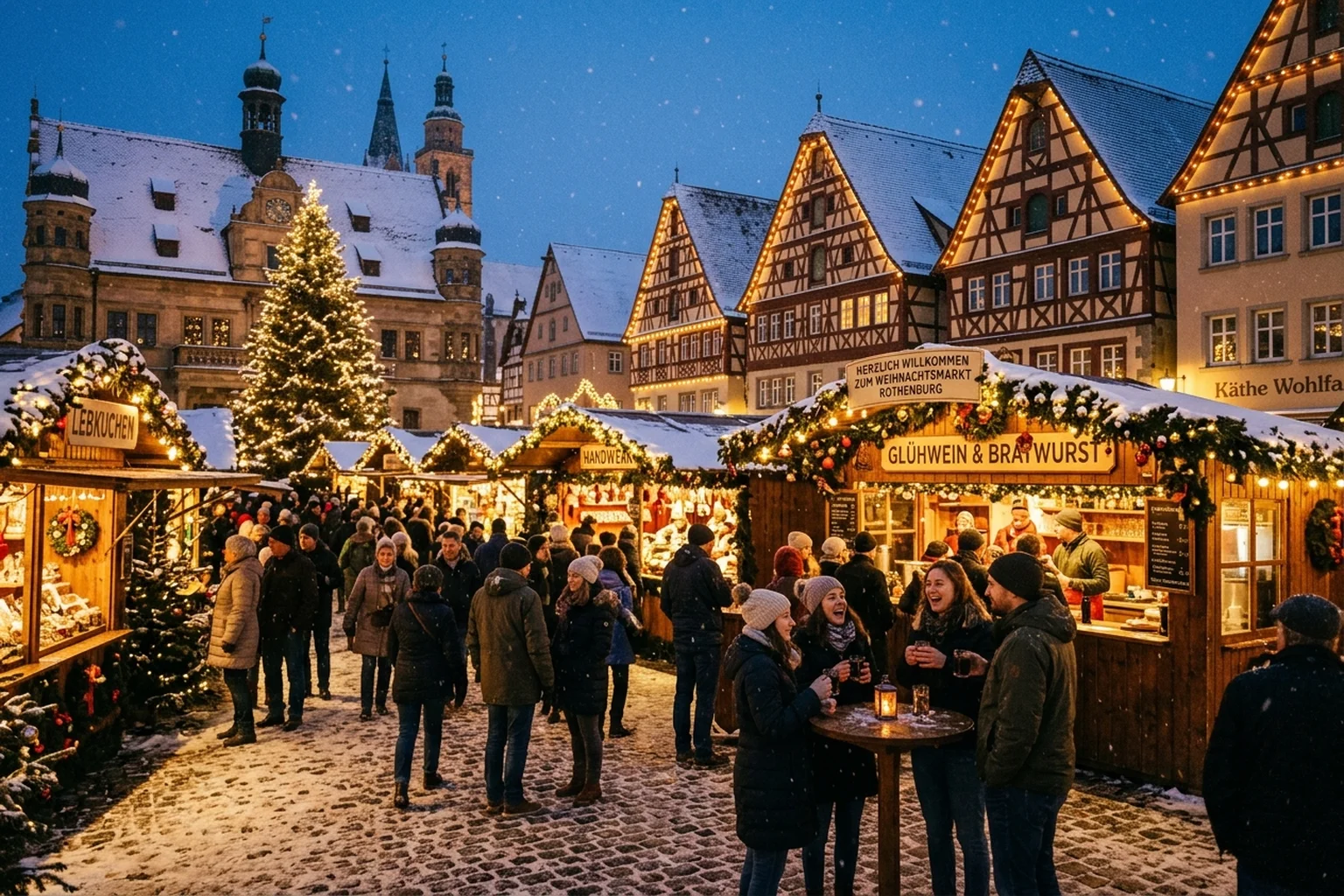
Here’s something nobody tells you about German Christmas markets: the thing that makes them charming is the same thing that makes them the single best working environment for a pickpocket in Europe.
Think about what the market actually asks of you. It’s dark by four. You’re in a dense, slow-moving crowd. You’re wearing gloves and a heavy coat with your wallet buried under two layers. Almost every stall is cash-only, so you’re pulling notes out repeatedly rather than tapping a card once. And you’re holding a hot ceramic mug in one hand for most of the evening, which means you’re doing all of this one-handed while distracted, warm, and slightly drunk.
That’s not a warning about Germany being dangerous. It isn’t. It’s a description of a specific set of conditions, and knowing they exist is most of the defense.
This guide covers the 2026 dates, how the mug deposit system works so you don’t get caught out at the first stall, and what the actual German crime numbers say about theft at these markets — which is more interesting than the scare stories suggest.
The short answer
- Most German Christmas markets open late November and close December 23 or 24 (almost none stay open past Christmas).
- Glühwein mugs use a €2–5 refundable deposit (Pfand). Return the mug to any drinks stall to get your cash back, or keep it as a dated souvenir.
- Bring cash in small notes and €1/€2 coins; many stalls still do not accept cards.
- Pickpocketing has a 6.9% police clearance rate — keep valuables in zippered front pockets or bags worn across your chest, never in outer coat pockets.
2026 dates for the major markets
| Market | 2026 dates |
|---|---|
| Munich — Christkindlmarkt, Marienplatz | Nov 20 – Dec 24 |
| Cologne — Cathedral market (7 markets citywide) | approx. Nov 23 – Dec 23 |
| Dresden — Striezelmarkt | approx. Nov 25 – Dec 24 |
| Nuremberg — Christkindlesmarkt | Nov 27 – Dec 24 |
| Frankfurt — Römerberg | late Nov – Dec 22 |
| Stuttgart | late Nov – Dec 23 |
| Dortmund | Nov 19 – Dec 30 |
| Düsseldorf | Nov 20 – Dec 30 |
| Berlin — 80+ markets | late Nov; closings range Dec 24 – Jan 6, 2027 |
Confirm on the official market website before you book flights, and here’s the honest reason why: sources disagree on several of these, and they’re not all wrong. Cologne runs seven separate markets on different schedules, so “Cologne opens November 23” and “Cologne opens November 25” can both be accurate. Dresden’s stalls often start serving before the ceremonial opening. Berlin has no single season at all. A few 2026 dates were still being finalized in mid-2026.
Timing notes that matter:
- Most German markets close December 23 or 24, not after Christmas. If you’re picturing a market between Christmas and New Year, you want Berlin, Dortmund, Düsseldorf, or Vienna, Prague and Budapest, which run to early January.
- December 24 is a half day — Munich’s Marienplatz market closes at 14:00.
- Munich’s Christkindlmarkt is closed on Totensonntag, November 22, 2026, by city regulation. It’s a national day of mourning, and it catches people who arrive that weekend.
- Weekday afternoons are dramatically quieter than weekend evenings. Marienplatz on a Saturday in December is genuinely overwhelming. If your schedule has any flex, use it here — it improves the experience and it removes most of your theft risk in one move.
The Pfand system, explained properly
This is the thing that confuses every first-time visitor at the very first stall, and half the guides online explain it slightly wrong.
When you order a Glühwein, you pay two things: the drink (€3–6) and a refundable deposit on the ceramic mug, called the Pfand (€2–5, usually €3–4). So your first drink costs €7–10 at the counter and it looks like you’ve been overcharged. You haven’t.
How it works:
- Refills cost only the drink price. Hand your mug back, get it filled, pay for the wine and no second deposit. This is the part people miss — they return the mug, get their deposit, then pay a fresh deposit at the next stall.
- Return it at the end for your deposit back, in cash, at any drinks stall.
- Keep it if you want it. The mugs are market-specific and usually dated, which makes them the cheapest good souvenir in Germany. Keeping it just means forfeiting the deposit you already paid.
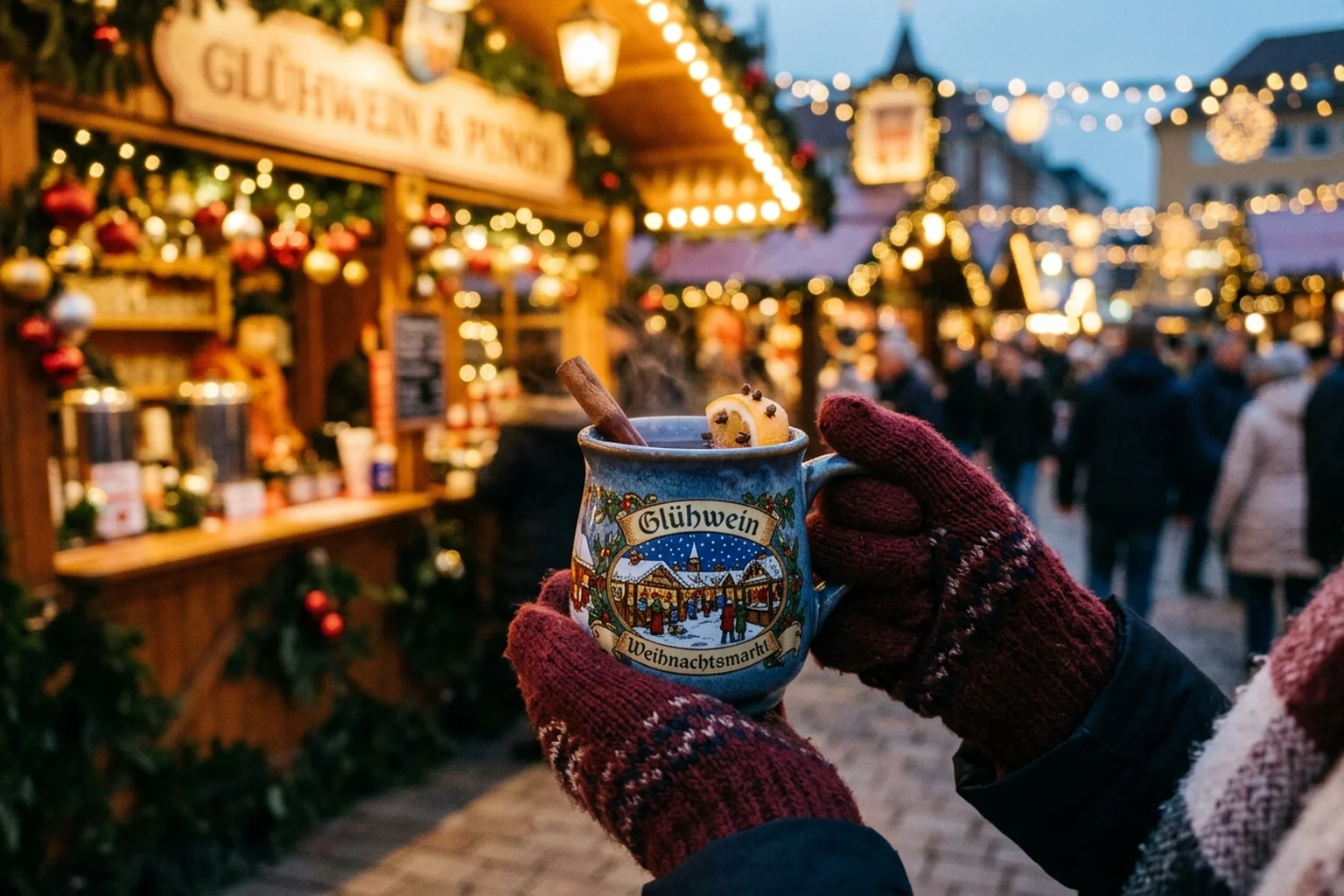
The nuance that costs people money: the deposit is refundable at any stall within the same market — not across different markets. A Gendarmenmarkt mug can’t be returned at Charlottenburg. In a city like Berlin or Cologne, where you’ll cross several separate markets in one evening, that matters. Return the mug before you move on.
Some stalls hand out tokens instead of refunding on the spot, and some run a loyalty scheme where a set number of tokens earns a free drink.
Not drinking? Kinderpunsch is the non-alcoholic version and it’s on every menu.
Bring cash. More than you think.
Card acceptance has improved at the big city markets, but the majority of stalls — especially food, ornaments, and anything artisan — are still cash-only.
Budget €30–40 per person for an evening of grazing, and bring it in small notes and coins. A full evening of two Glühweins, a bratwurst, something like Käsespätzle or Reibekuchen, and a sweet runs roughly €25–35, plus deposits floating in your pocket until you cash them back in.
Carry €1 and €2 coins specifically. The Pfand system runs on them, and stalls get short on change fast on a busy night.
This is also the crux of the theft problem, so let’s deal with it directly.
The pickpocket numbers, honestly
Most travel content on this topic is either “Germany is perfectly safe, relax” or breathless crime-wave stuff. The German federal police statistics say something more useful than either.
According to the Polizeiliche Kriminalstatistik, 95,184 pickpocketing offences were reported in Germany in 2025, down from 107,720 in 2024. Total losses fell too, from €52.4 million to €32.4 million. In North Rhine-Westphalia — Cologne, Düsseldorf, Dortmund — pickpocketing dropped 11 percent, about 4,400 fewer cases.
So the trend is genuinely improving. That’s the reassuring half.
Here’s the half that should change your behavior: the clearance rate is 6.9 percent. More than nine in ten pickpocketing cases in Germany are never solved, and the police are explicit about why — victims usually don’t notice at the time, so there’s nothing to act on until the trail is cold.
And the German federal police add a detail that rarely makes it into travel guides: insurance generally does not cover pickpocketing losses. Not the cash, and often not the replacement cost of the documents.
Put those together and the risk profile is clear. It isn’t that you’re likely to be robbed at a Christmas market. It’s that if it happens, essentially nothing happens afterward — no recovery, no arrest, no payout. Prevention is the only control you have, which is why it’s worth five minutes of thought rather than none.
How they actually work: German police describe teams operating with a division of labor — one person creates the distraction, another takes the item, and often a third takes the handoff so the thief isn’t holding anything if challenged. They favor crowds at events, shops, and public transport. And it’s not the demographic people expect: of 5,025 suspects registered in 2025, 11.6 percent were under 18.
The distraction is the whole trick. Someone bumps you, spills something, drops something, asks for directions, shows you a map or a clipboard, or a small child presses against your legs. The theft happens during the moment your attention goes elsewhere. If you learn one thing, learn that a sudden interruption in a crowd is the signal to put a hand on your bag, not to be helpful.
What to actually do:
- Front pockets only, or a zipped bag worn across the body and in front of you — not on your hip, not on your back.
- Split your money. Day’s cash in one pocket, backup card and emergency notes somewhere else entirely. Leave your passport at the hotel; you don’t need it at a market.
- Don’t put the phone on the table while you eat. Table-surface phone theft at market seating is its own category.
- Backpacks come off in crowds and get worn on the front, however silly it feels.
- Coat pockets are not storage. They’re the easiest target in the market, particularly with a mug in your hand.
- Photograph your cards and passport before you leave home and store them somewhere you can reach without your phone.
Security since Magdeburg: what it means practically
German Christmas markets have operated under visibly heavier security since the December 2024 vehicle attack in Magdeburg, which killed six people and injured hundreds, and the Berlin attack in 2016.
In practice, for your visit, this means: concrete vehicle barriers and bollards around market perimeters, more police presence, and bag checks at entrances to larger markets. Travel light. A big backpack will slow you down at the entry point and it’s the worst thing to be wearing in the crowd anyway.
It has also had a knock-on effect worth knowing at the planning stage: some smaller towns have cancelled their markets because they can’t afford the new security requirements. If your itinerary depends on a specific village market, confirm it’s actually running this year rather than assuming it runs because it always has.
One more thing, and it’s the reason I’m including this section at all: the Christmas market season now reliably generates viral misinformation. Euronews has fact-checked fabricated images of “heavily guarded” markets and false claims that German markets were being closed en masse. They weren’t. Before you cancel or re-route based on something you saw circulating, check the market’s own website or the city’s tourism office.
Every travel scam and every travel panic runs on the same fuel: you don’t know what normal looks like. That’s the whole reason I built Good Trip — scam warnings and local emergency numbers for Germany and 25 other countries, offline, free, no account, no data collected.
Which market, if you only get one
- Nuremberg: Red-and-white striped stalls, the Christkind opening ceremony, protected Nürnberger Lebkuchen, and famously strict about authenticity — no plastic, no piped music.
- Dresden: History: Dresden’s Striezelmarkt, first documented in 1434 and generally cited as Germany’s oldest.
- Cologne: Scale and easy access: Cologne, seven markets in the historic center, the Cathedral one alone drawing several million visitors.
- Munich: Families and an Alpine side trip: Munich.
- Berlin: Variety over spectacle: Berlin, where 80-plus neighborhood markets range from the polished Gendarmenmarkt to genuinely scruffy alternative markets in Kreuzberg. Berlin is also the only major city where you can find markets running past Christmas.
Be honest with yourself about one thing: not all markets are good. The gap between a well-curated market and a suburban one selling identical mass-produced ornaments is enormous, and both will be described online as “magical.”
Getting there in 2026
One planning note that didn’t apply the last time most people did this trip. If you’re flying in from outside Europe, you’ll now be processed through Europe’s new border system at your first Schengen entry point — which for most Christmas market trips means Frankfurt, Munich, or Düsseldorf.
Short version: your first entry involves fingerprints and a facial scan, peak waits at those airports have roughly doubled year over year, and 90-minute connections through Frankfurt no longer work. Allow three hours if you’re connecting onward, and three hours at the airport on the way home. The full guide has the details.
Planning a rail route between markets? Check our detailed itinerary in German Christmas Markets by Train, and review Europe’s entry rules for Americans before you fly.
Sources: Bundespolizei on pickpocketing and the 2025 Police Crime Statistics , Bundespolizei on pickpocket methods and team tactics , Police North Rhine-Westphalia, Crime Statistics 2025 , BKA Police Crime Statistics 2025 , Euronews on tightened Christmas market security , Nuremberg Christkindlesmarkt official site , Munich, Dresden, Cologne and Berlin city tourism offices for 2026 market dates .
Good Trip keeps local etiquette, scam warnings, emergency numbers, offline phrasebooks, and currency conversion on your phone. Download it before you fly.
Good Trip works 100% offline.
Curated culture tips, phrasebooks, scam warnings, and emergency data for Japan, Korea, Vietnam, Mexico, and 22 other countries.
Get Good Trip on the App Store →